
ABB 1SFL587263R1222 Block Contactor - AF Technology
Part Number: 1SFL587263R1222
Quick Summary
Block Contactor ABB AF 1SFL587263R1222 is designed for motor control in industrial automation. This device supports reliable switching in demanding panels, addressing voltage variation and energy waste that plague modern systems. The AF family delivers CE, UL/CSA, UKCA and CCC certifications, along with RoHS compliance, EAC approval, and UL A2L safety alignment. By combining wide control voltage tolerance with built‑in surge protection and a compact block design, this product reduces panel footprint while boosting reliability. For procurement teams and engineers, the ABB AF contactor offers a balanced mix of performance, compliance, and life‑cycle efficiency essential for cost‑effective automation projects.
Product Information
Extended Description
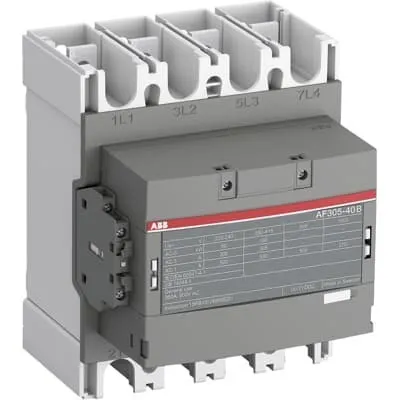
1SFL587263R1222 ABB: The AF305B-40-22-12 is a 4 pole - 1000 V IEC or 600 V UL contactor with pre-mounted auxiliary contacts and standard ferrules, controlling motors up to 160 kW / 400 V AC (AC-3) / and switching power circuits up to 500 A (AC-1) or 350 A UL general use. Thanks to the AF technology, the contactor has a wide control voltage range (48-130 V 50/60 Hz and DC), managing large control voltage variations, reducing panel energy consumptions and ensuring distinct operations in unstable networks. Furthermore, surge protection is built-in, offering a compact solution. AF contactors have a block type design, can be easily extended with add-on auxiliary contact blocks and an additional wide range of accessories.
Minimum Order Quantity
1 piece
Customs Tariff Number
85364900
Data Sheet, Technical Information
1SBC100214C0202 - Main catalog Motor protection and control Manual motor starters, contactors and overload relays (PDF) - Edition 2024
Data Sheet, Technical Information (Part 2)
Contactors and Overload relays guide
Instructions and Manuals
Operating instruction, Contactor, AF(S)190 ... AF(S)370
CAD Dimensional Drawing
Information - 2D and 3D files for CAD systems
Product Net Width
184 mm
Product Net Depth / Length
180 mm
Product Net Height
225 mm
Product Net Weight
5.7 kg
Number of Main Contacts NO
4
Number of Main Contacts NC
0
Number of Auxiliary Contacts NO
2
Number of Auxiliary Contacts NC
2
Number of Poles
4P
Rated Operational Voltage
Main Circuit 1000 V
Rated Operational Current AC-1 (Ie)
(1000 V) 40 °C 375 A | (1000 V) 60 °C 325 A | (1000 V) 70 °C 260 A | (690 V) 40 °C 500 A | (690 V) 60 °C 400 A | (690 V) 70 °C 325 A
Rated Operational Current AC-3 (Ie)
(415 V) 55 °C 305 A | (440 V) 55 °C 305 A | (380 / 400 V) 55 °C 305 A | (220 / 230 / 240 V) 55 °C 305 A
Rated Operational Current DC-1 (Ie)
(100 V) 1 Pole, 40 °C 500 A | (100 V) 1 Pole, 60 °C 400 A | (100 V) 1 Pole, 70 °C 325 A | (110 V) 1-Pole, 40 °C 500 A | (110 V) 1-Pole, 60 °C 400 A | (110 V) 1-Pole, 70 °C 325 A | (110 V) 2 Poles in Series, 40 °C 500 A | (110 V) 2 Poles in Series, 60 °C 400 A | (110 V) 2 Poles in Series, 70 °C 325 A | (110 V) 3 Poles in Series, 40 °C 500 A | (110 V) 3 Poles in Series, 60 °C 400 A | (110 V) 3 Poles in Series, 70 °C 325 A | (175 V) 2 Poles in Series, 40 °C 500 A | (175 V) 2 Poles in Series, 60 °C 400 A | (175 V) 2 Poles in Series, 70 °C 325 A | (200 V) 2 Poles in Series, 40 °C 500 A | (200 V) 2 Poles in Series, 60 °C 400 A | (200 V) 2 Poles in Series, 70 °C 325 A | (220 V) 2 Poles in Series, 40 °C 500 A | (220 V) 2 Poles in Series, 60 °C 400 A | (220 V) 2 Poles in Series, 70 °C 325 A | (220 V) 3 Poles in Series, 40 °C 500 A | (220 V) 3 Poles in Series, 60 °C 400 A | (220 V) 3 Poles in Series, 70 °C 325 A | (260 V) 3 Poles in Series, 40 °C 500 A | (260 V) 3 Poles in Series, 60 °C 400 A | (260 V) 3 Poles in Series, 70 °C 325 A | (300 V) 3 Poles in Series, 40 °C 500 A | (300 V) 3 Poles in Series, 60 °C 400 A | (300 V) 3 Poles in Series, 70 °C 325 A | (340 V) 3 Poles in Series, 40 °C 500 A | (340 V) 3 Poles in Series, 60 °C 400 A | (340 V) 3 Poles in Series, 70 °C 325 A | (350 V) 4 Poles in Series, 40 °C 500 A | (350 V) 4 Poles in Series, 60 °C 400 A | (350 V) 4 Poles in Series, 70 °C 325 A | (400 V) 4 Poles in Series, 40 °C 500 A | (400 V) 4 Poles in Series, 60 °C 400 A | (400 V) 4 Poles in Series, 70 °C 325 A | (440 V) 4 Poles in Series, 40 °C 500 A | (440 V) 4 Poles in Series, 60 °C 400 A | (440 V) 4 Poles in Series, 70 °C 325 A | (72 V) 1-Pole, 40 °C 500 A | (72 V) 1-Pole, 60 °C 400 A | (72 V) 1-Pole, 70 °C 325 A | (72 V) 2 Poles in Series, 40 °C 500 A | (72 V) 2 Poles in Series, 60 °C 400 A | (72 V) 2 Poles in Series, 70 °C 325 A | (72 V) 3 Poles in Series, 40 °C 500 A | (72 V) 3 Poles in Series, 60 °C 400 A | (72 V) 3 Poles in Series, 70 °C 325 A | (90 V) 1 Pole, 40 °C 500 A | (90 V) 1 Pole, 60 °C 400 A | (90 V) 1 Pole, 70 °C 325 A
Rated Operational Current DC-3 (Ie)
(110 V) 2 Poles in Series, 40 °C 400 A | (110 V) 2 Poles in Series, 60 °C 400 A | (110 V) 2 Poles in Series, 70 °C 325 A | (110 V) 3 Poles in Series, 40 °C 400 A | (110 V) 3 Poles in Series, 60 °C 400 A | (110 V) 3 Poles in Series, 70 °C 325 A | (220 V) 3 Poles in Series, 40 °C 400 A | (220 V) 3 Poles in Series, 60 °C 400 A | (220 V) 3 Poles in Series, 70 °C 325 A | (72 V) 2 Poles in Series, 40 °C 400 A | (72 V) 2 Poles in Series, 60 °C 400 A | (72 V) 2 Poles in Series, 70 °C 325 A | (72 V) 3 Poles in Series, 40 °C 400 A | (72 V) 3 Poles in Series, 60 °C 400 A | (72 V) 3 Poles in Series, 70 °C 325 A
Rated Operational Current DC-5 (Ie)
(110 V) 2 Poles in Series, 40 °C 400 A | (110 V) 2 Poles in Series, 60 °C 400 A | (110 V) 2 Poles in Series, 70 °C 325 A | (110 V) 3 Poles in Series, 40 °C 400 A | (110 V) 3 Poles in Series, 60 °C 400 A | (110 V) 3 Poles in Series, 70 °C 325 A | (220 V) 3 Poles in Series, 40 °C 400 A | (220 V) 3 Poles in Series, 60 °C 400 A | (220 V) 3 Poles in Series, 70 °C 325 A | (72 V) 2 Poles in Series, 40 °C 400 A | (72 V) 2 Poles in Series, 60 °C 400 A | (72 V) 2 Poles in Series, 70 °C 325 A | (72 V) 3 Poles in Series, 40 °C 400 A | (72 V) 3 Poles in Series, 60 °C 400 A | (72 V) 3 Poles in Series, 70 °C 325 A
Rated Operational Power AC-3 (Pe)
(415 V) 160 kW | (440 V) 160 kW | (500 V) 200 kW | (690 V) 250 kW | (1000 V) 185 kW | (380 / 400 V) 160 kW | (220 / 230 / 240 V) 90 kW
Rated Short-time Withstand Current Low Voltage (Icw)
at 40 °C Ambient Temp, in Free Air, from a Cold State 10 s 2440 A | at 40 °C Ambient Temp, in Free Air, from a Cold State 15 min 500 A | at 40 °C Ambient Temp, in Free Air, from a Cold State 1 min 996 A | at 40 °C Ambient Temp, in Free Air, from a Cold State 1 s 3050 A | at 40 °C Ambient Temp, in Free Air, from a Cold State 30 s 1409 A
Rated Insulation Voltage (Ui)
acc. to UL/CSA 1000 V
Mechanical Durability
5 million
Maximum Mechanical Switching Frequency
300 cycles per hour
Rated Control Circuit Voltage (Uc)
50 Hz / 60 Hz 48 ... 130 V | DC Operation 48 ... 130 V
Coil Consumption
Holding at Max. Rated Control Circuit Voltage 50 Hz 17 V·A | Holding at Max. Rated Control Circuit Voltage 60 Hz 17 V·A | Pull-in at Max. Rated Control Circuit Voltage 50 Hz 340 V·A | Pull-in at Max. Rated Control Circuit Voltage 60 Hz 340 V·A | Pull-in at Max. Rated Control Circuit Voltage DC 360 W
Power Loss
50 W | at Rated Operating Conditions per Pole 50 W
Terminal Type
Main Circuit: Bars
Product Name
Block Contactor
General Use Rating UL/CSA
(1000 V AC) 400 A
Horsepower Rating UL/CSA
(200 ... 208 V AC) Three Phase 40 Hp | (200 V AC) Three Phase 100 hp | (208 V AC) Three Phase 100 hp | (220 ... 240 V AC) Three Phase 50 Hp | (220 ... 240 V AC) Three Phase 125 hp | (440 ... 480 V AC) Three Phase 100 Hp | (440 ... 480 V AC) Three Phase 250 hp | (550 ... 600 V AC) Three Phase 150 Hp | (550 ... 600 V AC) Three Phase 300 hp
Conflict Minerals Reporting Template (CMRT)
CMRT - Conflict Minerals Reporting Template
REACH Declaration
REACH - Letter of Confirmation for block contactors, contactor relays, installation contactors, mini contactors, mini contactor relays, thermal overload relays, electronic overload relays and related accessories
RoHS Information
RoHS II declaration for block contactors, installation contactors, mini contactors, mini contactor relays, thermal overload relays, electronic overload relays and related accessories
RoHS Status
Following EU Directive 2011/65/EU and Amendment 2015/863 July 22, 2019
Toxic Substances Control Act - TSCA
Toxic Substances Control Act (TSCA) declaration for Contactors
WEEE B2C / B2B
Business To Business
WEEE Category
5. Small Equipment (No External Dimension More Than 50 cm)
ABB EcoSolutions
Yes
ABB Site Meeting Group Waste To Landfill Target
Non-hazardous waste is sent to a landfill, where there is no alternative option available within 100km of a facility
End Of Life Disassembling Instructions
End-of-life instruction - AF(S)265(B)-**(RT) to AF(S)370(B)-**(RT)
Environmental Product Declaration - EPD
Environmental Product Declaration, Contactors, AF(S)265-AF(S)370 (SE)
Improved Energy Efficiency for Customers
Product Efficiency - Product considered more energy-efficient compared to similar product on market or older products from the same line
Recyclability Rate of the Product acc. to EN45555
Design for Closing Resource Loops - Standard EN45555 - 76.3 %
Sustainable Material Content in Product (wt. %)
Recycled Metal - 33 %
A2L Certificate – UL
UL Certificate of Compliance A2L, Contactor, AF190 - AF370
CB Certificate
SEMKO_SE-73326
CQC Certificate
CQC Certificate, AC Contactor, AF265-*-*-*,AF305-*-*-*,AF370-*-*-*,AF265B-*-*-*,AF305B-*-*-*,AF370B-*-*-*, Made in Sweden
Declaration of Conformity - CCC
CCC Declaration of Conformity, AC Contactor, AF265-*-*-*,AF305-*-*-*,AF370-*-*-*,AF265B-*-*-*,AF305B-*-*-*,AF370B-*-*-*, Made in Sweden
Declaration of Conformity - CE
CE Declaration of Conformity - Contactor - AF116B...RT to AF370B...RT
Declaration of Conformity - UKCA
UK Declaration of Conformity - Contactors >100A - Rail application
EAC Certificate
9AKK107046A8618
UL Certificate
cULus Certificate, Contactor, AF265-40, AF305-40, AF370-40 (4-pole)
Package Level 1 Units
box 1 piece
Package Level 1 Width
212 mm
Package Level 1 Depth / Length
262 mm
Package Level 1 Height
212 mm
Package Level 1 Gross Weight
6.4 kg
Package Level 1 EAN
7320500511015
Object Classification Code
Q
ETIM 7
EC000066 - Power contactor, AC switching
ETIM 8
EC000066 - Power contactor, AC switching
ETIM 9
EC000066 - Power contactor, AC switching
eClass
V11.0 : 27371003
UNSPSC
39121529
IDEA Granular Category Code (IGCC)
4755 >> Contactors
E-Number (Sweden)
3210481
The AF four‑pole design provides robust motor switching with four main NO contacts and two NO plus two NC auxiliary contacts, enabling native signaling and streamlined control wiring, which translates to faster panel assembly and reduced wiring errors. This feature directly benefits plant uptime and maintenance planning by simplifying diagnostics and integration with existing control schemes. The wide control circuit voltage range of 48‑130 V (AC/ DC) minimizes panel energy waste and delivers stable operation even in networks with voltage variances, improving overall system efficiency and reducing energy costs. Mechanical durability of 5 million cycles ensures long service life in high‑duty applications, while a maximum mechanical switching frequency of 300 cycles per hour supports frequent on/off operations typical in conveyors, pumps, and fans. Built‑in surge protection and a compact block form factor further minimize panel space and harm‑free installation, with pre-mounted auxiliary contacts and compatibility with add‑on contact blocks for scalable control. Coil consumption values, including 340 V·A pull‑in and 360 W DC pull‑in, reflect efficient energization, and the coil holding current remains low at rated CV, reducing thermal load and energy use. Terminal design using main circuit bars simplifies busbar connections and enhances EMI performance, making this solution a solid fit for MCCs and machine control panels. Industry professionals appreciate the combination of cost‑effective maintenance, high fault tolerance, and straightforward retrofits in legacy systems, particularly where 690–1000 V motor circuits are prevalent.
Get a Quick Quote for a ABB 1SFL587263R1222
Chat with us on WhatsApp - fast responses guaranteed
Need to speak with someone? We'll call you back within 2 hours during business hours
Interested in ABB 1SFL587263R1222?
Enquire Now
FAQs
Install the four‑pole main contactor using standard busbars with main circuit bars and secure the auxiliary contact blocks as required. Verify coil voltage is within 48‑130 V AC/DC and ensure correct wiring of the NO/NC auxiliary contacts for signaling. Confirm compatibility with your MCC or machine control panel and observe torque specifications for busbar connections to minimize contact resistance.
For AC‑1 at 690 V, the device supports up to 400 A, and at 1000 V up to 375 A 40–70°C, with variation by ambient temperature. AC‑3 ratings deliver up to 305 A at 415–440 V, with substantial motor protection during starting and switching. These ratings enable reliable motor starting for motors sized up to several hundred kilowatts, depending on voltage and temperature.
Yes. With four poles and built‑in surge protection, the ABB AF contactor is designed for demanding environments, including conveyors, pumps, and fans. Its wide coil voltage tolerance and robust mechanical durability (up to 5 million cycles) offer reliable operation despite voltage fluctuations and frequent switching, reducing maintenance and replacement intervals in harsh industrial settings.
The AF contactor carries CE and UKCA declarations, UL/CSA certifications for general use, CCC/EAC recognition, RoHS compliance, and a UL certificate for AF series 4‑pole configurations. This broad certification set supports global procurement, regulatory compliance, and safer integration into varied electrical environments.
ROI benefits come from energy efficiency due to compact coil consumption, reduced energy waste across wide voltage tolerance, and longer service life (5 million mechanical cycles). The device also lowers total cost of ownership through easy expansion with auxiliary blocks, smaller panel footprints, and fewer failures in unstable networks—delivering reliable uptime and lower maintenance costs over the system’s life cycle.