
ABB 2CQG100117R1021 ASPECT Control Engine - IP20
Part Number: 2CQG100117R1021
Quick Summary
ASPECT Control Engine provides an embedded runtime and web UI for scalable automation across building and industrial processes. Many teams face challenges integrating BACnet MS/TP, Modbus RTU, and TCP/IP while expanding device counts. CE marking, RoHS compliance, and IP20 protection ensure safe, compliant operation in typical plant environments. ABB MATRIX ACE consolidates these protocols into a single gateway, simplifying commissioning and ongoing maintenance. The upgrade path supports up to 2,500 points and 128 devices, enabling cost-effective scalability for retrofit projects and new builds. With web-based configuration and remote diagnostics, teams shorten downtime and accelerate validation during commissioning. This improves project ROI across multi-site deployments.
Product Information
Extended Description
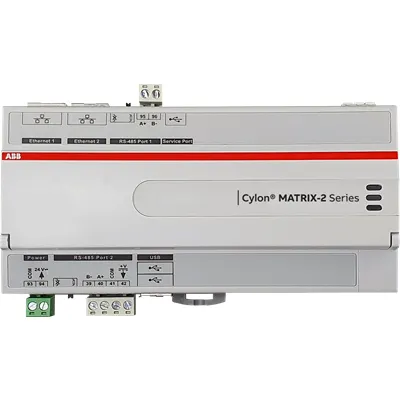
2CQG100117R1021 ABB: MATRIX ACE (ASPECT Control Engine) with embedded ASPECT runtime engine and web UI, includes 2 EIA-485 ports, configurable for 9.6 to 115.2 kbps, capable of supporting upto a total of 96 devices (either MS/TP or TCP/IP) or 2,000 points. Support for 2 RS-485 protocols (BACnet MS/TP, Modbus RTU, AAM PUP or Teletrol TSC), and a maximum of 64 MS/TP devices per port. One RJ-45 10/100 MB Ethernet port with TCP/IP support for FT/Net, BACnet/IP, Modbus TCP and Cylon UC32.netK. Field upgrade-able to support a maximum of 2,500 points and 128 devices as a combination of either TCP/IP or MS/TP connections.
Instructions and Manuals
MATRIX-2 Series User Guide (PDF)[EN]
Ambient Air Temperature
-25 … 50 °C
Degree of Protection
IP20
Data Sheet, Technical Information
Data sheet MATRIX-2 Series [RU] | Operating Instruction MATRIX-2 Series [RU]
Communication Interface
IP, MS/TP
Analog Inputs
0
Analog Outputs
0
Number of Batteries
0
Supply Voltage
24 … 24 V
Voltage Range
19.2 ... 28.8 V
Input Voltage Type
AC/DC
Power Consumption (@Pcons)
20 V·A
Product Net Width
90 mm
Product Net Height
57 mm
Product Net Depth / Length
163 mm
Product Net Weight
0.3 kg
Dimension Diagram
MATRIX-2 Series.dxf
RoHS Information
CE marking CBXi FBXi eSCi MATRIX-2
RoHS Status
Following EU Directive 2011/65/EU
Conflict Minerals Reporting Template (CMRT)
Conflict Minerals Reporting Template
WEEE Category
5. Small Equipment (No External Dimension More Than 50 cm)
WEEE B2C / B2B
Business To Business
Declaration of Conformity - CE
CE marking CBXi FBXi eSCi MATRIX-2
ETIM 9
EC011487 - Free programmable controller
Feature: Embedded ASPECT runtime with web UI enables on-device logic execution and browser-based configuration. Business Impact: Reduces external software dependencies and speeds up commissioning, particularly in multi-site deployments. Application: Ideal for building automation, energy management, and process control where quick turn-up and remote diagnostics matter. Feature: Two EIA-485 ports supporting BACnet MS/TP, Modbus RTU, AAM PUP, and Teletrol TSC. Business Impact: Enables flexible integration with legacy field devices and a scalable MS/TP/TCP network up to 96 devices or 2,000 points. Application: Retrofit projects and new installations in factories and campuses with mixed protocols. Feature: One RJ-45 10/100 Ethernet port with TCP/IP support for BACnet/IP, Modbus TCP and UC32.netK. Business Impact: Unlocks BACnet/IP interoperability and remote monitoring via standard Ethernet networks. Application: Centralized monitoring, integration with FT/Net, and remote configuration for facilities management. Feature: Field upgrade path to 2,500 points and 128 devices across TCP/IP or MS/TP. Business Impact: Protects upfront investment and extends lifecycle as system requirements grow. Application: Scalable deployments and phased upgrades in manufacturing and building automation. Feature: Compact dimensions, IP20 enclosure, and wide supply range (24 V, 19.2–28.8 V, AC/DC) with 20 VA consumption. Business Impact: Space-efficient, energy-tolerant hardware suitable for control closets and panel boards. Application: Front-desk installations in cabinets, retrofit of existing panels, and integration with ABB MATRIX-2 Series.
Get a Quick Quote for a ABB 2CQG100117R1021
Chat with us on WhatsApp - fast responses guaranteed
Need to speak with someone? We'll call you back within 2 hours during business hours
Interested in ABB 2CQG100117R1021?
Enquire Now
FAQs
Begin by ensuring a 24 V supply within 19.2–28.8 V and mounting the unit in an IP20 enclosure. Connect the two EIA-485 ports, configure baud rates between 9.6 and 115.2 kbps, and select BACnet MS/TP or Modbus RTU per port. Use the embedded web UI for device addressing and network topology, then verify MS/TP device counts and gateway routing per MATRIX-2 Series guides.
The system supports up to 96 devices or 2,000 points across MS/TP and TCP/IP combined, with up to 64 MS/TP devices per port. A field upgrade path increases capacity to 128 devices and 2,500 points when project requirements grow, preserving investment while enabling larger automation networks.
Yes. The ABB MATRIX ACE consolidates BACnet MS/TP, Modbus RTU, BACnet/IP, and Modbus TCP in a single gateway, facilitating retrofits by syncing with existing devices and protocols. Its compact IP20 housing, 24 V supply, and scalable point/device capacity help minimize refurbishment time and enable phased deployments in commercial buildings and industrial facilities.
The product complies with CE marking and RoHS directives, supports WEEE guidelines, and carries IP20 protection for indoor control panel use. It also aligns with ETIM classification EC011487 and related safety and environmental standards, helping with regulatory reporting and supplier qualification in complex automation projects.
The embedded runtime and web UI simplify ongoing maintenance by enabling remote diagnostics and configuration without on-site visits. The scalable upgrade path reduces total cost of ownership, improves lifecycle planning, and accelerates commissioning for multi-site deployments, delivering faster time-to-value and a lower risk profile for automation initiatives.