
ABB 2TFH100024R1001 Moulded Case Breaker - 4P IEC60947-2
Part Number: 2TFH100024R1001
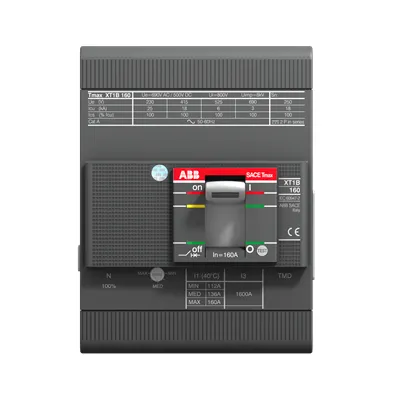
Quick Summary
ABB 2TFH100024R1001 Moulded Case Breaker provides reliable AC/DC protection for industrial power distribution panels. In space-constrained control cabinets, engineers need protection that fits, coordinates with upstream devices, and ships with complete compliance documentation. This unit supports CE conformity, IEC60947-2 and GB/T 14028.2 standards, RoHS and CMRT reporting to streamline regulatory and sustainability requirements. Built for SACE Tmax XT installations, it offers straightforward front-terminal wiring and robust performance in automation and machine-building environments, helping reduce downtime and maintenance cost while improving panel safety. With a rated current of 32 A and an operating range of 690 V AC / 500 V DC, it protects demanding loads while maintaining energy efficiency with about 2.1 W per pole. The 4P design simplifies wiring and future upgrades.
Product Information
Extended Description
2TFH100024R1001 ABB: XT1B160 TMD32/450 FFC 4P
Environmental Product Declaration - EPD
NoDecNee
REACH Declaration
REACh Declaration ABB Sace circuit breakers
RoHS Information
RoHS Declaration ABB Sace circuit breakers
RoHS Status
Following EU Directive 2011/65/EU and Amendment 2015/863 July 22, 2019
Conflict Minerals Reporting Template (CMRT)
CMRT - Conflict Minerals Reporting Template
Environmental Information
Breakers - Packaging disposal information
Customs Tariff Number
85362000
Product Main Type
SACE Tmax XT
Product Name
Moulded Case Circuit Breaker
Product Type
Automatic Circuit Breaker
Version
F
Current Type
AC/DC
Electrical Durability
8000 cycle | 120 cycles per hour
Mechanical Durability
25000 cycle | 240 cycles per hour
Number of Poles
4P
Power Loss
at Rated Operating Conditions per Pole 2.1 W
Rated Current (In)
32 A
Rated Impulse Withstand Voltage (Uimp)
8 kV
Rated Insulation Voltage (Ui)
800 V
Rated Operational Voltage
690 V AC | 500 V DC
Rated Service Short-Circuit Breaking Capacity (Ics)
(220 V AC) 25 kA | (230 V AC) 25 kA | (240 V AC) 25 kA | (380 V AC) 18 kA | (415 V AC) 18 kA | (440 V AC) 11.5 kA | (500 V AC) 8 kA | (525 V AC) 6 kA | (690 V AC) 3 kA | (250 V DC) 2 Poles in Series 18 kA | (500 V DC) 3 Poles in Series 18 kA
Rated Ultimate Short-Circuit Breaking Capacity (Icu)
(220 V AC) 25 kA | (230 V AC) 25 kA | (240 V AC) 25 kA | (380 V AC) 18 kA | (415 V AC) 18 kA | (440 V AC) 15 kA | (500 V AC) 8 kA | (525 V AC) 6 kA | (690 V AC) 3 kA | (250 V DC) 2 Poles in Series 18 kA | (500 V DC) 3 Poles in Series 18 kA
Rated Uninterrupted Current (Iu)
160 A
Release
TMD
Release Type
TM
Short-Circuit Performance Level
B
Standards
IEC60947-2 | GB/T 14028.2
Sub-type
XT1
Terminal Connection Type
Front for Copper Cables
Data Sheet, Technical Information
SACE Tmax XT IEC Low voltage molded case circuit-breakers Catalog | SACE Tmax XT IEC TECHNICAL CHARACTERISTICS Low voltage molded case circuit-breakers
Declaration of Conformity - CE
EC Declaration of Conformity Tmax XT1
Instructions and Manuals
Installation instructions XT1
WEEE Category
5. Small Equipment (No External Dimension More Than 50 cm)
4P protection and AC/DC current capability deliver robust multi‑phase fault isolation, reducing the risk of cascading trips and minimizing unplanned downtime in complex panel networks. It is ideal for motor drives and machine controls in automation environments where reliability is paramount. The 32 A rated current paired with a 690 V AC / 500 V DC operating range ensures suitable coverage for a wide range of automated equipment, enabling streamlined protection coordination and fewer replacements due to undersized devices in switchgear assemblies and control panels. The device’s 8 kV impulse withstand and 800 V insulation provide strong surge resilience against transients, safeguarding sensitive drives and PLCs in plants with frequent switching or long cable runs. Power loss of 2.1 W per pole and high durability (8000 electrical cycles, 25000 mechanical cycles) translate to energy efficiency and longer service life, reducing cooling needs and maintenance costs in high-cycle lines. Compliance and compatibility with IEC60947-2, GB/T 14028.2, RoHS, REACH, CMRT, and WEEE category 5 supports global deployment and streamlined approvals, while the front‑terminal copper connections ease installation and retrofit projects across diverse panel environments.
Get a Quick Quote for a ABB 2TFH100024R1001
Chat with us on WhatsApp - fast responses guaranteed
Need to speak with someone? We'll call you back within 2 hours during business hours
Interested in ABB 2TFH100024R1001?
Enquire Now
FAQs
The unit uses a front-terminal connection designed for copper cables, enabling straightforward, safe wiring during initial assembly or retrofits. Verify conductor size and torque per ABB installation instructions, then secure the breaker firmly in the panel to ensure reliable tripping and consistent electrical contact.
Key ratings include rated current of 32 A, rated operational voltage of 690 V AC / 500 V DC, and rated insulation voltage of 800 V. An 8 kV impulse withstand supports transient robustness, while 2.1 W per pole indicates energy efficiency. These specs suit industrial distribution and motor control in high-voltage panels.
Yes. It is part of the SACE Tmax XT family with XT1 sub-type and TM release, offering reliable motor protection and panel protection in automation environments. It integrates with standard Tmax XT hardware and documentation, supporting consistent performance across machine control applications.
This breaker is CE compliant with the Declaration of Conformity, supports IEC60947-2 and GB/T 14028.2, and provides RoHS, REACH declarations, CMRT for conflict minerals, and WEEE categorization for end-of-life handling. These documents simplify global procurement and regulatory reporting.
Electrical durability is rated at 8000 cycles and mechanical durability at 25000 cycles, reducing replacement frequency. With 2.1 W per pole power loss and robust surge protection, you gain energy efficiency and lower cooling costs, translating to lower maintenance spend and improved uptime in high-cycle production environments.