
ABB 2TFH100063R1001 Moulded Case Circuit Breaker - 40 kA Icu
Part Number: 2TFH100063R1001
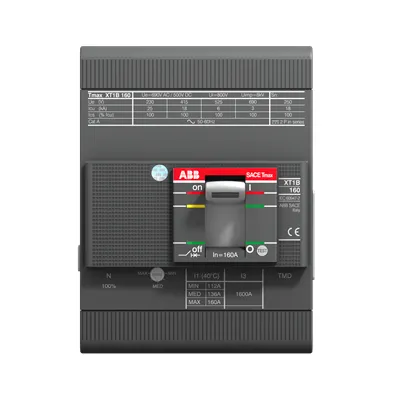
Quick Summary
ABB 2TFH100063R1001 Moulded Case Circuit Breaker is a protective device used to safely interrupt faults in industrial power panels. In high-density electrical systems, nuisance trips and undersized protection can cause costly downtime and safety risks. This unit conforms to IEC 60947-2 and GB/T 14028.2, with CE conformity and RoHS compliance, aligning with the SACE Tmax XT family for reliable automation protection. As part of ABB’s Tmax XT XT1 lineage, it integrates seamlessly with panel boards and automation cabinets, delivering robust protection while supporting efficient, scalable electrical layouts for modern factories.
Product Information
Extended Description
2TFH100063R1001 ABB: XT1C160 TMD40/450 FFC 4P
Environmental Product Declaration - EPD
NoDecNee
REACH Declaration
REACh Declaration ABB Sace circuit breakers
RoHS Information
RoHS Declaration ABB Sace circuit breakers
RoHS Status
Following EU Directive 2011/65/EU and Amendment 2015/863 July 22, 2019
Conflict Minerals Reporting Template (CMRT)
CMRT - Conflict Minerals Reporting Template
Environmental Information
Breakers - Packaging disposal information
Customs Tariff Number
85362000
Product Main Type
SACE Tmax XT
Product Name
Moulded Case Circuit Breaker
Product Type
Automatic Circuit Breaker
Version
F
Current Type
AC/DC
Electrical Durability
8000 cycle | 120 cycles per hour
Mechanical Durability
25000 cycle | 240 cycles per hour
Number of Poles
4P
Power Loss
at Rated Operating Conditions per Pole 2.6 W
Rated Current (In)
40 A
Rated Impulse Withstand Voltage (Uimp)
8 kV
Rated Insulation Voltage (Ui)
800 V
Rated Operational Voltage
690 V AC | 500 V DC
Rated Service Short-Circuit Breaking Capacity (Ics)
(220 V AC) 40 kA | (230 V AC) 40 kA | (240 V AC) 40 kA | (380 V AC) 25 kA | (415 V AC) 25 kA | (440 V AC) 12.5 kA | (500 V AC) 9 kA | (525 V AC) 8 kA | (690 V AC) 4 kA | (250 V DC) 2 Poles in Series 25 kA | (500 V DC) 3 Poles in Series 25 kA
Rated Ultimate Short-Circuit Breaking Capacity (Icu)
(220 V AC) 40 kA | (230 V AC) 40 kA | (240 V AC) 40 kA | (380 V AC) 25 kA | (415 V AC) 25 kA | (440 V AC) 25 kA | (500 V AC) 18 kA | (525 V AC) 8 kA | (690 V AC) 4 kA | (250 V DC) 2 Poles in Series 25 kA | (500 V DC) 3 Poles in Series 25 kA
Rated Uninterrupted Current (Iu)
160 A
Release
TMD
Release Type
TM
Short-Circuit Performance Level
C
Standards
IEC60947-2 | GB/T 14028.2
Sub-type
XT1
Terminal Connection Type
Front for Copper Cables
Data Sheet, Technical Information
SACE Tmax XT IEC Low voltage molded case circuit-breakers Catalog | SACE Tmax XT IEC TECHNICAL CHARACTERISTICS Low voltage molded case circuit-breakers
Declaration of Conformity - CE
EC Declaration of Conformity Tmax XT1
Instructions and Manuals
Installation instructions XT1
WEEE Category
5. Small Equipment (No External Dimension More Than 50 cm)
The 4P front-terminal design for copper cables simplifies installation, reducing wiring errors and speeding panel assembly, which translates to lower commissioning time and labor costs. With a 40 A rated current and a 690 V AC / 500 V DC operating range, it supports mid-range industrial loads while maintaining safe, predictable protection in motor feeders and distribution circuits. The device delivers high fault protection capabilities, with Ics up to 40 kA and Icu up to 40 kA across common low-voltage configurations, helping prevent busbar damage and unplanned downtime. The TMD release with TM characteristics provides precise, predictable tripping, enhancing system reliability in automation lines and machine rooms. Durability figures—8,000 electrical cycles and 25,000 mechanical cycles—mean longer service life under frequent switching, lowering maintenance intervals and total cost of ownership. Compliance with IEC 60947-2 and GB/T 14028.2, plus CE and RoHS declarations, reduces regulatory risk and simplifies audits. The product is designed for easy panel mounting, with a front-terminal connection optimized for copper cabling, and aligns with the SACE Tmax XT ecosystem to ensure future-proof compatibility within automated manufacturing environments. In practice, this translates to faster install times, improved up-time, and a clear path to scalable protection as plant automation expands.
Get a Quick Quote for a ABB 2TFH100063R1001
Chat with us on WhatsApp - fast responses guaranteed
Need to speak with someone? We'll call you back within 2 hours during business hours
Interested in ABB 2TFH100063R1001?
Enquire Now
FAQs
This MCCB uses a front-terminal connection designed for copper cables. For proper installation, ensure conductors match the rated cross-section, tighten to the manufacturer’s recommended torque, and route cables to avoid bending stresses. The front-terminal design simplifies feeder routing in compact panels and reduces the risk of miswiring during panel assembly.
The device provides a Rated Service Short-Circuit Breaking Capacity (Ics) up to 40 kA and a Rated Ultimate Short-Circuit Breaking Capacity (Icu) up to 40 kA across relevant voltages (including 220–240 V). At higher voltages such as 380–440 V, the Ics/Icu ratings adjust per standard tables, offering robust protection for feeders and machine lines while maintaining selectivity with upstream protection.
Yes. The device is designed to IEC 60947-2 standards and GB/T 14028.2, with a CE Declaration of Conformity. It also carries RoHS declarations, ensuring restricted substance compliance for European and global installations and simplifying regulatory audits for panel assemblies.
The 4P front-terminal arrangement enables straightforward, space-efficient wiring for multi-pole feeders, reducing installation time and risk of cross-wiring. It enhances accessibility for inspection and testing and supports quick replacement in maintained systems, all while maintaining a compact footprint suitable for modern distribution boards in automation environments.
The XT1-based Tmax XT MCCBs deliver electrical durability of about 8000 cycles and mechanical durability around 25000 cycles, supporting frequent switching without accelerated wear. This translates to longer maintenance intervals, lower replacement costs, and improved total cost of ownership for critical production lines and automated machinery.