
ABB 2TFH100166R1001 Moulded Case Circuit Breaker - IEC 60947-2
Part Number: 2TFH100166R1001
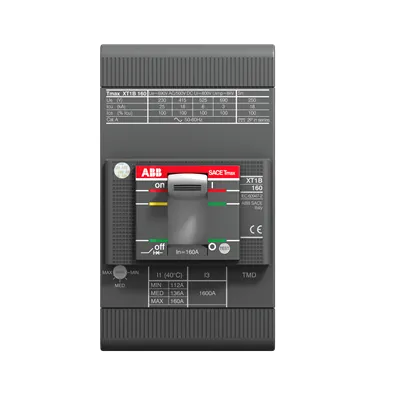
Quick Summary
Moulded Case Circuit Breaker ABB 2TFH100166R1001 protects industrial power systems by interrupting fault currents in distribution panels. Engineers often struggle with nuisance trips and protection coordination; this MCCB delivers reliable short-circuit protection and easy upstream coordination. Certified to IEC 60947-2 with CE conformity and RoHS compliance, and traceable DoC, it aligns with global safety and environmental requirements. Ideal for ABB SACE Tmax XT installations and modern low-voltage systems, it supports scalable panel protection, reduces downtime, and streamlines maintenance and replacement planning.
Product Information
Extended Description
2TFH100166R1001 ABB: XT1H160 TMD160/1600 FEF 3P
Environmental Product Declaration - EPD
NoDecNee
REACH Declaration
REACh Declaration ABB Sace circuit breakers
RoHS Information
RoHS Declaration ABB Sace circuit breakers
RoHS Status
Following EU Directive 2011/65/EU and Amendment 2015/863 July 22, 2019
Conflict Minerals Reporting Template (CMRT)
CMRT - Conflict Minerals Reporting Template
Environmental Information
Breakers - Packaging disposal information
Customs Tariff Number
85362000
Product Main Type
SACE Tmax XT
Product Name
Moulded Case Circuit Breaker
Product Type
Automatic Circuit Breaker
Version
F
Current Type
AC/DC
Electrical Durability
8000 cycle | 120 cycles per hour
Mechanical Durability
25000 cycle | 240 cycles per hour
Number of Poles
3P
Power Loss
at Rated Operating Conditions per Pole 15 W
Rated Current (In)
160 A
Rated Impulse Withstand Voltage (Uimp)
8 kV
Rated Insulation Voltage (Ui)
800 V
Rated Operational Voltage
690 V AC | 500 V DC
Rated Service Short-Circuit Breaking Capacity (Ics)
(220 V AC) 75 kA | (230 V AC) 75 kA | (240 V AC) 75 kA | (380 V AC) 52.5 kA | (415 V AC) 37.5 kA | (440 V AC) 32.5 kA | (500 V AC) 25 kA | (525 V AC) 17.5 kA | (690 V AC) 5 kA | (250 V DC) 2 Poles in Series 52.5 kA | (500 V DC) 3 Poles in Series 52.5 kA
Rated Ultimate Short-Circuit Breaking Capacity (Icu)
(220 V AC) 100 kA | (230 V AC) 100 kA | (240 V AC) 100 kA | (380 V AC) 70 kA | (415 V AC) 70 kA | (440 V AC) 65 kA | (500 V AC) 50 kA | (525 V AC) 35 kA | (690 V AC) 10 kA | (250 V DC) 2 Poles in Series 70 kA | (500 V DC) 3 Poles in Series 70 kA
Rated Uninterrupted Current (Iu)
160 A
Release
TMD
Release Type
TM
Remarks
ATLAS
Short-Circuit Performance Level
H
Standards
IEC60947-2 | GB/T 14028.2
Sub-type
XT1
Terminal Connection Type
Front Extended
Data Sheet, Technical Information
SACE Tmax XT IEC Low voltage molded case circuit-breakers Catalog | SACE Tmax XT IEC TECHNICAL CHARACTERISTICS Low voltage molded case circuit-breakers
Declaration of Conformity - CE
EC Declaration of Conformity Tmax XT1
Instructions and Manuals
Installation instructions XT1
WEEE Category
5. Small Equipment (No External Dimension More Than 50 cm)
Feature: 3P 160 A rated current enables use across medium-sized distribution panels. Business Impact: Matches typical industrial loads with precise protection, reducing over-tripping and downtime. Application: Suitable for motor control centers and control panels in manufacturing environments. The ABB Tmax XT family compatibility ensures seamless integration with upstream protection schemes and downstream devices, improving overall safety coordination. Feature: Front Extended terminal connections simplify installation in dense enclosures. Business Impact: Speeds up wiring, minimizes installation errors, and reduces panel fabrication time. Application: Ideal for retrofit projects and new builds in compact switchgear. Feature: High fault current withstand with Ics up to 75 kA (and up to 100 kA Icu at select voltages) enhances reliability for peak fault events. Business Impact: Improves system availability and protects critical equipment during faults. Application: Motor feeders and heavy-duty distribution circuits. Feature: Electrical and mechanical durability rated at 8000 electrical cycles and 25000 mechanical cycles. Business Impact: Extends service life, lowers maintenance costs, and lowers lifecycle ownership risk. Application: Frequent switching in automated lines and packaging facilities. Feature: Rated insulation voltage 800 V and operating voltage 690 VAC / 500 V DC deliver versatile performance. Business Impact: Broad compatibility with modern low-voltage networks and mixed AC/DC systems. Application: Panel boards, machine decks, and panel-mounted protection.
Get a Quick Quote for a ABB 2TFH100166R1001
Chat with us on WhatsApp - fast responses guaranteed
Need to speak with someone? We'll call you back within 2 hours during business hours
Interested in ABB 2TFH100166R1001?
Enquire Now
FAQs
The device uses Front Extended terminal connections, which simplifies wiring in tight panel spaces and aligns with common control panel layouts. This configuration reduces installation time, minimizes wiring errors, and supports straightforward retrofits in existing switchgear without requiring major enclosure redesigns.
Key ratings include 160 A rated current, 800 V rated insulation voltage, 690 VAC / 500 V DC rated operational voltage, and 8 kV impulse withstand voltage. Short-circuit ratings range with Ics up to 75 kA and Icu up to 100 kA depending on voltage, providing strong fault-ride-through capability for industrial feeders.
Yes. The 2TFH100166R1001 is part of ABB’s SACE Tmax XT family, designed for low-voltage protection in motor control centers and associated control panels. Its release type TM with TMD mechanism supports selective coordination within Tmax XT configurations, aiding reliability and maintainability in MCC installations.
The unit complies with IEC 60947-2 and GB/T 14028.2 standards, carries CE conformity, and RoHS compliance. The DoC provides traceability and aligns with global safety, environmental, and regulatory requirements for industrial protection devices.
With electrical durability rated at 8000 cycles and mechanical durability at 25000 cycles, the MCCB supports frequent switching with reduced risk of premature wear. Its energy loss of about 15 W per pole minimizes heat generation in panels, contributing to lower cooling requirements and extended equipment life in high-demand production lines.