
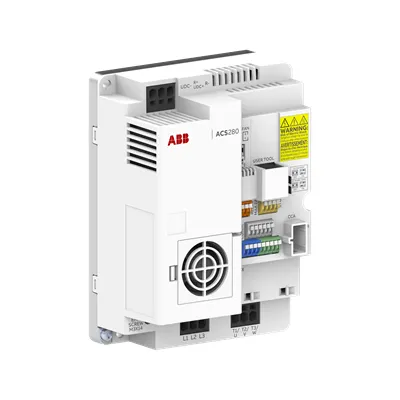
ABB ACS280 Drive 3AXD50001071806 - 2.2 kW, 12.2 A
Part Number: 3AXD50001071806
Quick Summary
The ABB ACS280 drive enables precise motor control for industrial automation and machine applications. Engineers often struggle to fit robust drives into compact panels while maintaining ease of configuration and reliable operation. CE marking and standard industrial protections are common expectations; for SIL-rated safety features and IP ratings, always consult the official datasheet. By standardizing on ABB's drive family, maintenance teams benefit from consistent parameter sets, faster commissioning, and reduced spare-part variety, translating into faster time-to-production and lower total cost of ownership. The ABB ecosystem supports scalable solutions across multiple machines, enabling smoother upgrades without retraining operators or reconfiguring control logic, protecting your automation investment.
Product Information
Feature: 2.2 kW nominal power with 12.2 A input current provides reliable speed and torque control for mid-range automation. Business impact: ensures smooth starting, reduced mechanical stress, and improved process stability on conveyors, packaging lines, and machine tools. Application: ideal for line sections requiring precise motion while keeping electrical demand predictable. Feature: compact form factor supports easy panel mounting and simplified wiring. Business impact: saves valuable cabinet space, accelerates commissioning, and lowers installation costs. Application: retrofits and new builds where space is tight or retrofit projects are ongoing. Feature: built-in diagnostics and fault reporting streamline maintenance planning. Business impact: reduces downtime, speeds root-cause analysis, and enables condition-based service. Application: production floors with frequent changeovers and varying load profiles. Feature: compatibility with ABB motor and drive ecosystems simplifies commissioning and maintenance. Business impact: reduces training time, speeds integration, and minimizes spare-part variety. Application: multi-machine lines requiring consistent parameter sets and centralized control. Feature: robust performance with standard compliance expectations for industrial environments. Business impact: meets regulatory expectations while supporting energy efficiency targets and lifecycle cost reductions. Application: large-scale manufacturing facilities prioritizing reliability and long-term total cost of ownership.
Get a Quick Quote for a ABB 3AXD50001071806
Chat with us on WhatsApp - fast responses guaranteed
Need to speak with someone? We'll call you back within 2 hours during business hours
Interested in ABB 3AXD50001071806?
Enquire Now
FAQs
The drive has a 2.2 kW nominal power rating with an input current of 12.2 A, suitable for mid-range motor control in industrial automation. The model number identifies the exact ABB ACS280 configuration, ensuring predictable performance when paired with compatible ABB motors and control systems.
Yes. The ACS280 is designed to integrate with ABB motor systems and ABB control architectures, providing streamlined wiring, consistent parameter sets, and faster commissioning. When integrating, verify the voltage, current, and protection requirements and use appropriate ABB-compatible connectors and software tools.
Ideal for conveyors, packaging lines, and machine automation where precise speed and torque control are required. Its compact footprint makes it suitable for panel-mounted installations, while its performance supports consistent production throughput and reduced wear on mechanical components.
Confirm CE marking and enclosure protection appropriate for your environment, and reference the official datasheet for any region-specific safety features such as SIL capabilities and IP ratings. If your application has stringent safety or environmental requirements, consult ABB documentation and your electrical engineer for conformity assessment.
The ACS280 provides reliable operation with built-in diagnostics, which reduces unscheduled downtime and speeds fault isolation. Its compatibility within the ABB ecosystem simplifies spare parts and training, leading to faster commissioning, lower lifecycle costs, and a favorable return on investment through improved energy efficiency and productive uptime.