
Eaton LTB125 Liquidator Connector - Hazardous Locations
Part Number: LTB125
Quick Summary
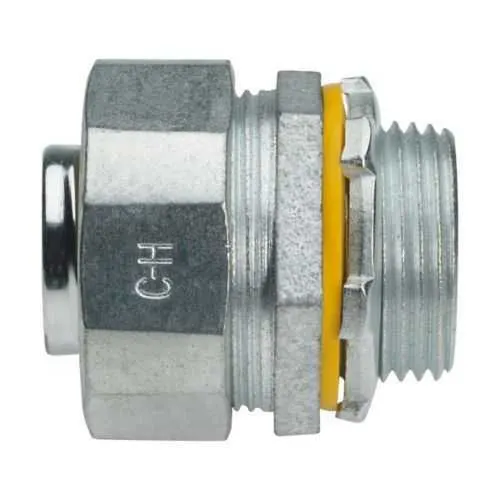
LTB125 Liquidator liquidtight connector provides a rugged FMC solution for field wiring in hazardous locations. Engineers often contend with ingress protection and code approvals when routing conductors in tight spaces. This connector is designed to meet NEC/CEC requirements with hazardous-location ratings including Class I Division 2, Class II Division 1 and 2, and Class III, helping you stay compliant. Its malleable iron body and insulated construction combine durability with safe terminations, while the 1-1/4 inch trade size supports common industrial runs. With straightforward FMC compatibility and a compact footprint, LTB125 enables faster installations and reduced downtime on busy projects.
Product Information
Extended Description
LTB125 Eaton Crouse-Hinds: Eaton Crouse-Hinds series Liquidator liquidtight connector, FMC, Straight, Insulated, Malleable iron, 1-1/4"
Product Name
Eaton Crouse-Hinds series Liquidator liquidtight connector
Catalog Number
LTB125
UPC
784564311252
Product Length/Depth
2.19 in
Product Height
2.25 in
Product Width
2.25 in
Product Weight
0.55 lb
Area classification
Hazardous/Classified Locations
Standards type
NEC/CEC
NEC hazardous rating
Class I, Division 2 Class II, Division 1 Class II, Division 2 Class III
Conduit type
FMC
Connector type
Straight
Material
Malleable iron
Insulator
Insulated
Trade size
1-1/4"
Eaton Crouse-Hinds LTB125 3D drawing
Crouse-Hinds series Malleable and Aluminum Liquidtight Fittings catalog page
Metallic Liquidtight Fittings UL certification
Metallic Liquidtight Fittings UL certification
Eaton Specification Sheet - LTB125
Feature → Business Impact → Application: The LTB125 uses a malleable iron body with insulated construction and a straight FMC connector tailored for a 1-1/4 inch trade size. This combination delivers rugged mechanical protection and a reliable, insulated termination, ideal for connecting FMC conduit to equipment enclosures in harsh environments. Feature → Business Impact → Application: NEC/CEC compliance and hazardous-location ratings (Class I Division 2; Class II Division 1/2; Class III) simplify regulatory approvals and reduce field rework, accelerating project timelines in oil, gas, mining, and chemical processing facilities. Feature → Business Impact → Application: Compact dimensions (2.19 in long, 2.25 in high and wide) and a light 0.55 lb weight enable space-efficient installations in panels and tight equipment rooms, reducing crew time during terminations. Feature → Business Impact → Application: Availability of documentation and CAD assets (3D drawings, catalogs, spec sheets) supports seamless design integration, improving accuracy and shortening procurement cycles. Feature → Business Impact → Application: Insulated construction enhances safety and moisture resilience in damp or wet environments, contributing to longer service life and lower maintenance in hazardous area deployments.
Get a Quick Quote for a Eaton Crouse-Hinds LTB125
Chat with us on WhatsApp - fast responses guaranteed
Need to speak with someone? We'll call you back within 2 hours during business hours
Interested in Eaton Crouse-Hinds LTB125?
Enquire Now
FAQs
The LTB125 is a straight Liquidator liquidtight connector designed specifically for FMC conduit with a 1-1/4 inch trade size, providing a secure, insulated termination suitable for hazardous locations.
The LTB125 carries NEC/CEC compliance with hazardous-location ratings including Class I Division 2; Class II Division 1 & 2; and Class III, along with area classification of Hazardous/Classified Locations.
It is used to terminate FMC conduit to equipment enclosures in hazardous environments such as oil and gas facilities, chemical processing plants, and mining operations, especially where space is constrained.
Support materials include 3D CAD drawings, product catalogs, UL certification references, and the Eaton specification sheet to assist with design validation and regulatory compliance.
The straight configuration and compact footprint streamline terminations in tight spaces, reducing installation time and potential rework, while compliant ratings help minimize regulatory delays and maintenance costs over the life of the installation.