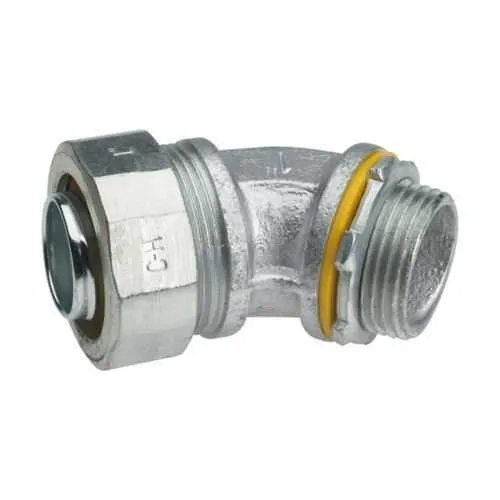
Eaton Crouse-Hinds LTB25045 Liquidator liquidtight connector - Hazardous/Classified Locations
Part Number: LTB25045
Quick Summary
Liquidator liquidtight connector provides a secure FMC conduit connection for hazardous-location electrical installations. In cramped spaces and harsh environments, maintaining enclosure integrity and compliance can be challenging. This model supports hazardous/classified locations under NEC/CEC with ratings for Class I, Division 2; Class II, Division 1 and 2; and Class III. Designed for a 2-1/2 inch trade size, insulated malleable iron construction, and a 45° angle, it delivers reliable performance while reducing maintenance costs and downtime. By combining rugged material with rigorous standards, fabricators and maintenance teams can accelerate installation, enhance safety, and meet regulatory deadlines.
Product Information
Extended Description
LTB25045 Eaton Crouse-Hinds: Eaton Crouse-Hinds series Liquidator liquidtight connector, FMC, 45° angle, Insulated, Malleable iron, 2-1/2"
Product Name
Eaton Crouse-Hinds series Liquidator liquidtight connector
Catalog Number
LTB25045
UPC
784564462503
Product Length/Depth
8.31 in
Product Height
8.31 in
Product Width
4 in
Product Weight
5.73 lb
Area classification
Hazardous/Classified Locations
Standards type
NEC/CEC
NEC hazardous rating
Class I, Division 2 Class II, Division 1 Class II, Division 2 Class III
Conduit type
FMC
Connector type
45° angle
Material
Malleable iron
Insulator
Insulated
Trade size
2-1/2"
Eaton Crouse-Hinds LTB25045 3D drawing
Crouse-Hinds series Malleable and Aluminum Liquidtight Fittings catalog page
Metallic Liquidtight Fittings Canadian certification
Metallic Liquidtight Fittings Canadian certification
Eaton Specification Sheet - LTB25045
The first feature is a 2-1/2 inch trade size FMC configuration with a 45° angle, made from malleable iron and fully insulated. This delivers superior mechanical strength and a secure seal, reducing ingress paths and protecting conductors in demanding environments. The business impact is improved enclosure integrity and longer service intervals, enabling faster installations on production lines and in outdoor industrial spaces where space is tight and routing is complex. In practical terms, the application spans chemical, oil, and refining facilities where Liquidator fittings streamline conduit routing and maintain compliance while keeping work crews safe from exposure to energized parts. A second feature is certified for hazardous and classified locations under NEC/CEC standards, including Class I Division 2, Class II Division 1 and 2, and Class III ratings. The business impact is regulatory peace of mind, reduced inspection risk, and easier audit trails for plant safety programs. This is particularly valuable for refineries, petrochemical plants, and power-generation sites where strict classification controls are routine and uptime is critical. The application benefit is faster permit approvals and predictable maintenance cycles, thanks to documented compliance with recognized standards. A third feature is insulated construction and durable malleable iron, shielding conductors from moisture, chemical exposure, and arcing risks in hazardous environments. The business impact is lower failure rates and reduced rework, translating into lower lifecycle costs and wider operating windows for maintenance work. In practice, technicians can install with confidence in FMC fittings, knowing the component resists wear and maintains a robust seal over time in harsh environments. A fourth feature is the documented compatibility with Liquidator line fittings and the availability of CAD drawings and catalogs for design integration. The business impact is streamlined engineering and faster project handoffs, reducing design lead times and the likelihood of field modification. In applications such as plant expansions or retrofits, engineers can import 3D models and verify fitment before procurement, accelerating procurement cycles while ensuring correct orientation and termination. A fifth feature is the tangible footprint provided by the 8.31 in length/depth and 4 in width with a weight around 5.73 lb, offering a compact yet sturdy option for tight installations. The business impact is reduced installation time and easier handling during conduit fabrications. In practice, installers gain predictable fitment in constrained spaces, improving overall project scheduling and on-site safety. A final consideration is the 45° angle connector design paired with an insulated, malleable iron body that resists deformation during tightening and alignment operations. The application benefit is consistently reliable terminations in challenging layouts, minimizing rework caused by misalignment and ensuring robust protection for downstream electrical equipment. This translates to measurable efficiency gains, safer work practices, and a lower total cost of ownership over the equipment’s life cycle.
Get a Quick Quote for a Eaton Crouse-Hinds LTB25045
Chat with us on WhatsApp - fast responses guaranteed
Need to speak with someone? We'll call you back within 2 hours during business hours
Interested in Eaton Crouse-Hinds LTB25045?
Enquire Now
FAQs
Install the LTB25045 by aligning the 2-1/2" trade size FMC conduit with the 45° angle connector body, ensuring the insulating seal is seated, and tightening to the manufacturer’s torque spec. Verify the enclosure is rated for the hazardous location class, then conduct a pre-installation insulation check and post-installation integrity test to confirm proper sealing and termination.
Yes. The LTB25045 is specifically designed for 2-1/2" FMC trade size and features a 45° angle connector. This combination facilitates routing in tight spaces while maintaining a secure, liquidtight seal. Always verify conduit compatibility and follow NEC/CEC requirements for termination in hazardous locations.
The LTB25045 is rated for hazardous/classified locations and aligns with NEC/CEC standards. It supports Class I, Division 2; Class II, Division 1 and 2; and Class III classifications, enabling use in oil, gas, chemical, and other demanding environments while meeting recognized safety and installation practices.
Benefits include enhanced enclosure integrity, reduced risk of moisture ingress, and dependable termination in harsh environments. The insulated malleable iron body resists corrosion and arcing, while the 45° angle simplifies routing in tight spaces. Overall, this translates to lower maintenance costs, shorter installation times, and improved safety compliance.
Regular inspections should confirm the integrity of the sealing, grounding connections, and absence of corrosion on the malleable iron body. Replace gaskets or seals if signs of wear appear and re-torque connections per the recommended specifications after any service activity. For critical hazardous locations, perform periodic integrity tests aligned with plant safety programs.