
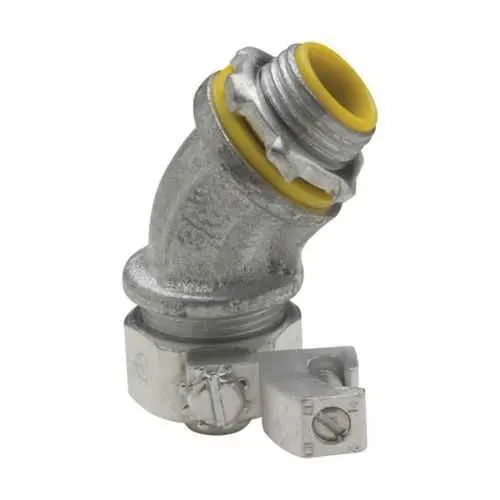
Eaton Crouse-Hinds LTB30045G Liquidator - 45° FMC Class I Div 2
Part Number: LTB30045G
Quick Summary
Eaton Crouse-Hinds LTB30045G Liquidator is a rugged liquidtight connector designed for FMC fittings in hazardous environments. Engineers often struggle with sealing integrity and installation complexity in hazardous locations, and this part provides robust grounding and a reliable 45° connection. It meets NEC/CEC standards, includes UL-certified metallic fittings, and supports hazardous area classifications including Class I Division 2. With a 3-inch trade size, aluminum ground lug, and #1/0–8 AWG lug range, this solution helps contractors reduce assembly time and improve compliance. Designed for FMC systems, it features an insulated body, malleable iron construction, and a durable aluminum ground lug for secure grounding in corrosive environments.
Product Information
Extended Description
LTB30045G Eaton Crouse-Hinds: Eaton Crouse-Hinds series Liquidator liquidtight connector, FMC, 45° angle, Aluminum ground lug, Insulated, #1/0-8 AWG lug size, Malleable iron, 3"
Product Name
Eaton Crouse-Hinds series Liquidator liquidtight connector
Catalog Number
LTB30045G
UPC
784564264282
Product Length/Depth
8.75 in
Product Height
8.75 in
Product Width
4.19 in
Product Weight
8.69 lb
Area classification
Hazardous/Classified Locations
Standards type
NEC/CEC
NEC hazardous rating
Class I, Division 2 Class II, Division 1 Class II, Division 2 Class III
Conduit type
FMC
Connector type
45° angle
Material
Malleable iron
Insulator
Insulated
Trade size
3"
Ground lug material
Aluminum
Lug size
#1/0-8 AWG
Eaton Crouse-Hinds LTB30045G 3D drawing
Crouse-Hinds series Malleable and Aluminum Liquidtight Fittings catalog page
Metallic Liquidtight Fittings UL certification
Metallic Liquidtight Fittings UL certification
Eaton Specification Sheet - LTB30045G
Feature: The 45° angle Liquidator liquidtight connector for FMC conduit is designed to maximize space efficiency in control panels and equipment enclosures. Business impact: it reduces installation time and improves sealing integrity, lowering field service calls and warranty claims. Application: ideal for hazardous locations and compact automation cabinets where a right-angle connection is required to maintain code-compliant routing. Feature: Ground lug materials and lug range provide robust electrical bonding with an aluminum ground lug and #1/0-8 AWG capacity. Business impact: lighter installation, easier torque management, and durable grounding across environments prone to moisture, dust, and corrosion. Application: suitable for process plants, water treatment, and mining gear where reliable grounding is critical for safety and compliance. Feature: Insulated construction and malleable iron body deliver mechanical strength, thermal resilience, and splash resistance. Business impact: longer service life, reduced maintenance cycles, and lower lifecycle cost for equipment exposed to temperature swings and vibration. Application: service entry points, junctions, and motor feeders in hazardous locations where harsh chemicals or EMI considerations exist. Feature: NEC/CEC compliance with multiple hazardous area ratings (Class I Division 2; Class II Division 1 and 2; Class III) plus UL certifications ensures regulatory acceptance and warehouse readiness. Business impact: speeds up approvals, simplifies supplier qualification, and helps project teams meet strict electrical codes. Application: industrial automation projects in chemical processing, oil and gas, and automated material handling where safety certification matters most. Feature: Availability of documentation and CAD resources (3D drawing, catalog pages, datasheets) aids rapid BOM creation and accurate procurement. Business impact: streamlines engineering workflows, minimizes procurement delays, and supports digital twins. Application: design teams can reference the Eaton specification sheet and UL reports during early-stage design and installation planning to reduce risk and ambiguity. Feature: Clear dimensional data (8.75 in length and height, 4.19 in width, 8.69 lb weight) supports precise space planning and enclosure sizing. Business impact: avoids over- or under-sizing cabinets, improves thermal management, and speeds enclosure fabrication. Application: pre-purchase analysis for control rooms, switchgear, and hazardous-area installations where precise spatial planning is critical.
Get a Quick Quote for a Eaton Crouse-Hinds LTB30045G
Chat with us on WhatsApp - fast responses guaranteed
Need to speak with someone? We'll call you back within 2 hours during business hours
Interested in Eaton Crouse-Hinds LTB30045G?
Enquire Now
FAQs
The LTB30045G combines a 45° FMC connector with an insulated malleable iron body and an aluminum ground lug, delivering a tight, vibration-resistant seal suitable for hazardous locations. Its design minimizes routing challenges in confined spaces and enhances grounding reliability, making it ideal for control panels, pump stations, and process lines in chemical plants or mining facilities.
Key specs include a 3 inch trade size, #1/0–8 AWG lug capacity, aluminum ground lug, 8.75 inch length, 4.19 inch width, and 8.69 lb weight. It is a malleable iron, insulated connector rated for FMC conduit with a 45° angle, supporting Class I Division 2, along with NEC/CEC standards for hazardous locations.
Yes. The LTB30045G aligns with NEC/CEC standards and UL certifications, supporting Class I Division 2 and related hazardous location classifications. This compliance streamlines procurement, regulatory approval, and supplier qualification for industrial automation projects, reducing risk and accelerating project delivery in regulated environments.
For proper grounding, use the aluminum ground lug with a #1/0–8 AWG conductor and ensure a continuous bonding path to the enclosure. Follow torque specifications from Eaton’s datasheet, verify a solid seal, and maintain proper conductor insulation. The insulated body aids in maintaining insulation during bonding while the lug provides robust, corrosion-resistant grounding.
LTB30045G lowers total project time by offering a ready-made, code-compliant solution with available 3D CAD drawings, catalogs, and datasheets for fast BOM integration. The 45° routing simplifies enclosure layouts, reducing installation labor and field rework, which translates to lower maintenance costs and more predictable delivery on automation projects.