
Eaton C0150E3AFB Industrial Control Transformer - UL Listed
Part Number: C0150E3AFB
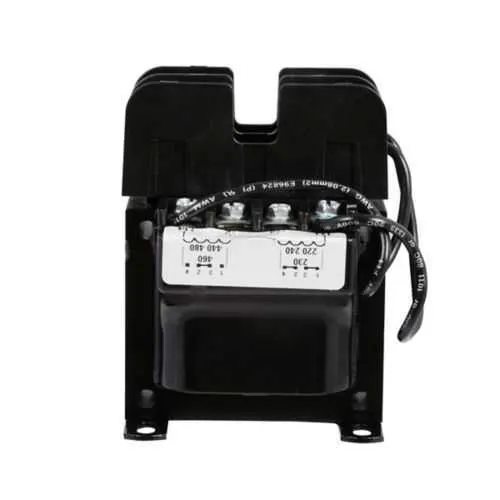
Quick Summary
Eaton Type MTE industrial control transformer provides reliable low-voltage power for control circuits in manufacturing equipment. In the field, mismatched fusing and brittle terminations drive downtime—this unit uses epoxy encapsulation and molded-in terminals to reduce service calls. It carries CSA Certified, UL Listed, and cUL Certified marks, RoHS compliance, and a 55°C insulation rating for robust operation in harsh environments. With a compact 150 VA rating and a 208/277 V primary to 120 V secondary, it fits control panels and automation systems while ensuring easy maintenance and reliable performance.
Product Information
Extended Description
C0150E3AFB Eaton: Eaton Type MTE industrial control transformer, pv: 208/277v, sv: 120 V, 55°c, 150 VA
Product Name
Eaton Type MTE industrial control transformer
Catalog Number
C0150E3AFB
UPC
786680550652
Product Length/Depth
3.88 in
Product Height
4.67 in
Product Width
3.75 in
Product Weight
5.5 lb
Warranty
Eaton Selling Policy 25-000, one (1) year from the date of installation of the Product or eighteen (18) months from the date of shipment of the Product, whichever occurs first.
Compliances
RoHS Compliant
Certifications
CSA Certified UL Listed cUL Certified
Catalog Notes
Epoxy encapsulated, Laminations of high quality silicon steel to minimize core losses and optimize performance, 50/60Hz operation, 130°C insulation system standard, Molded-in terminals for maximum durability
Coil material
Copper windings
Design
MTE
Tap size
None
Primary voltage
208/277 V
Temperature rating
55°C
Volt ampere rating
150 VA
Secondary voltage
120 V
Modification 1
Factory-mounted two-pole primary fuse block for non-rejection type fuses
Special features
Primary fuse block
Epoxy encapsulated construction with high-quality silicon steel laminations minimizes core losses and improves heat management, reducing energy waste and extending service life in continuous-duty automation panels. Copper windings promote efficient energy transfer and improved voltage regulation, delivering stable control signals to PLCs and relays in demanding applications. The 208/277 V primary to 120 V secondary configuration simplifies integration with typical plant power distribution, enabling rapid panel design and fewer converters. A factory-mounted two-pole primary fuse block enhances safety and reduces field wiring during installation, delivering faster commissioning and fewer wiring errors. Molded-in terminals resist vibration and environmental wear, increasing reliability in harsh industrial environments. The 55°C insulation system supports hotter enclosures, while RoHS compliance and multiple certifications (UL, CSA, cUL) ensure regulatory alignment for safe machine builds.
Get a Quick Quote for a Eaton C0150E3AFB
Chat with us on WhatsApp - fast responses guaranteed
Need to speak with someone? We'll call you back within 2 hours during business hours
Interested in Eaton C0150E3AFB?
Enquire Now
FAQs
The C0150E3AFB transformer features a primary voltage of 208/277 V and a secondary voltage of 120 V. This enables safe, reliable control signals for 120 V devices while adapting to common plant power supplies.
Yes. With a 120 V secondary and 150 VA rating, it powers typical PLC inputs and relays in control panels. Its epoxy encapsulation and molded-in terminals enhance durability in vibration-prone environments, while the integrated fuse block simplifies wiring.
The unit is UL Listed, CSA Certified, and cUL Certified, plus RoHS compliant. These marks indicate compliance with North American safety and environmental standards, easing procurement, auditing, and regulatory acceptance across facilities.
They’re widely used in machine control and automation panels, powering 120 V control circuits from higher plant voltages. The compact 150 VA rating suits coil loads, PLC logic, and relay matrices while simplifying panel layouts.
The factory-mounted two-pole primary fuse block reduces wiring complexity, lowers install time, and improves safety by centralizing overcurrent protection. This translates to faster commissioning, fewer field wiring errors, and improved uptime during maintenance.