
Eaton CB4033B120208RAOCT7 Pringle switch - UL Listed
Part Number: CB4033B120208RAOCT7
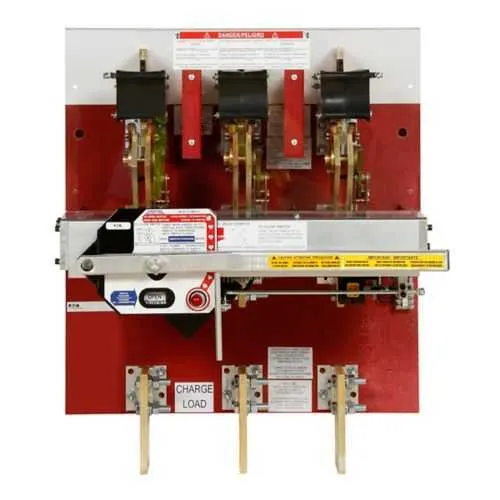
Quick Summary
Eaton CB4033B120208RAOCT7 is a bolted pressure contact switch designed for high-current motor control. Engineers often struggle with phase failures and fuse outages that cause costly downtime in harsh industrial environments. UL Listed certification along with robust NEMA ratings for 1, 3R, 4 and 12 provide reliable enclosure protection and compliance. This unit also supports 120 V control voltage and 208 V system voltage, delivering dependable control and protection while enabling straightforward integration into existing panels. The 2NO/2NC auxiliary contacts expand control logic options, improving monitoring and interlock capabilities for progressive maintenance programs.
Product Information
Extended Description
CB4033B120208RAOCT7 Eaton: Eaton pringle bolted pressure contact switch w/ Elec-Trip-Mech, 120/208V, 4000A, Bottom Feed, Phase Failure Relay, Blown Fuse (L-OFF, DNT), 2NO/2NC Aux
Product Name
Eaton pringle bolted pressure contact switch
Catalog Number
CB4033B120208RAOCT7
UPC
786689647803
Product Length/Depth
22.5 in
Product Height
32 in
Product Width
40 in
Product Weight
430 lb
Certifications
UL Listed
Catalog Notes
With Phase Failure Relay, Blown Fuse (L-OFF, DNT), 2NO/2NC Aux
Contact configuration
2 NO-2 NC
Feed type
Bottom
Fuse configuration
Bottom feed
Ground
No ground fault
Number Of Poles
Three-pole
Number of wires
3
Type
Pringle bolted pressure contact switch
Amperage Rating
4000A
Control voltage
120 V
NEMA rating
NEMA 1, NEMA 3R, NEMA 4, NEMA 12
Protection
Fusible
System voltage
208 V
Voltage - max
208 V
Voltage rating
208 V
Special features
Single-phase voltage relay with capacitor trip device (SPVR), BFD with no lights (trips switch)
ARMS Enclosed Circuit Breaker
ARMS Enclosed Circuit Breaker
ARMS Enclosed Circuit Breaker
ARMS Enclosed Circuit Breaker
Eaton Specification Sheet - CB4033B120208RAOCT7
Feature → Business Impact → Application: The CB4033B120208RAOCT7 delivers a 4000 A amperage rating, enabling direct switching of large motor loads without external starters, reducing system complexity and wiring costs in panel design. This translates to measurable improvements in efficiency and downtime reduction for heavy-duty applications, such as conveyors or pumps in harsh environments. Application: Ideal for industrial control panels requiring high current handling with minimal assembly steps and robust protection.
Get a Quick Quote for a Eaton CB4033B120208RAOCT7
Chat with us on WhatsApp - fast responses guaranteed
Need to speak with someone? We'll call you back within 2 hours during business hours
Interested in Eaton CB4033B120208RAOCT7?
Enquire Now
FAQs
The CB4033B120208RAOCT7 is designed for bottom feed installation and uses a three-pole configuration with 3 wires, accommodating 120 V control and 208 V system voltages. Its 2NO/2NC auxiliary contacts support expanded control logic, making it easy to integrate with standard control circuits and interlock schemes in industrial panels.
This device includes a Phase Failure Relay and a Fusible protection scheme (L-OFF, DNT), along with a 4000 A amperage rating. Together, these features help prevent nuisance trips, protect motors from phase loss, and ensure safe shutdown during fault conditions in demanding environments.
Yes. It carries UL Listed approval and is compatible with NEMA ratings 1, 3R, 4, and 12, indicating suitability for indoor panels, outdoor enclosures, and washdown areas. Bottom feed and robust construction further support reliability in challenging conditions typical of manufacturing and processing facilities.
Plan for a bottom-feed, three-pole configuration with three conductors, ensuring 120 V control circuits and 208 V mains connections are correctly wired. The device’s three-pole design and 2NO/2NC auxiliaries simplify interlocks and feedback wiring, while UL Listing helps satisfy regulatory and safety requirements for panel installations.
By consolidating protection with Phase Failure Relay, Fusible protection, and high current capacity into a single unit, downtime decreases due to reduced fault events and simpler maintenance. The long-term cost savings come from improved reliability, fewer spare parts for separate components, and faster commissioning in high-current motor control applications.