
Eaton CB4033T120208RAXCT Bolted pressure switch - UL Listed
Part Number: CB4033T120208RAXCT
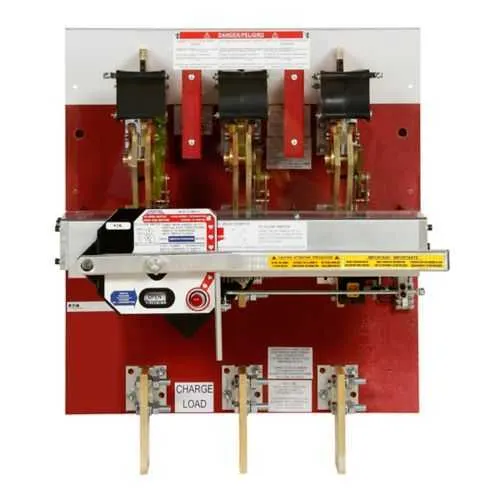
Quick Summary
CB4033T120208RAXCT is a bolted pressure contact switch designed for high-current motor protection in industrial switchgear. Many users struggle with nuisance trips or slow protection response that disrupts uptime. UL Listed safety certification and compatibility with NEMA enclosures (1, 3R, 4, 12) support code-compliant installations in demanding environments. Designed to integrate with Eaton Switching Devices for scalable, cost‑effective protection with 120 V control and 208 V system voltage. Optional Ground Fault Relay and auxiliary contact provisions offer added protection and flexibility in panel layouts. Its compact integration with a top-feed, three-pole design also simplifies retrofit projects and reduces wiring complexity.
Product Information
Extended Description
CB4033T120208RAXCT Eaton: Eaton pringle bolted pressure contact switch,Single-phase relay with capacitor trip device (SPVR), BFD with no lights (trips switch),,4000A,120V,Top feed,No ground fault,208V,Three-pole,Three-wire,Fusible
Product Name
Eaton pringle bolted pressure contact switch
Catalog Number
CB4033T120208RAXCT
UPC
782116950379
Product Length/Depth
17 in
Product Height
28 in
Product Width
40 in
Product Weight
390 lb
Warranty
Eaton Selling Policy 25-000, one (1) year from the date of installation of the Product or eighteen (18) months from the date of shipment of the Product, whichever occurs first.
Certifications
UL Listed
Catalog Notes
OPTIONAL Ground Fault Relay, Blown Fuse Detection, Single Phase Protection, Kirk Provisions, Auxiliary Contact Provisions, AVAILABLE.
Feed type
Top
Fuse configuration
Top feed
Ground
No ground fault
Number Of Poles
Three-pole
Number of wires
3
Switch type
Electrical trip with charge-before-close mechanism
Type
Pringle bolted pressure contact switch
Amperage Rating
4000A
Control voltage
120 V
NEMA rating
NEMA 1, NEMA 3R, NEMA 4, NEMA 12
Protection
Fusible
System voltage
208 V
Voltage - max
208 V
Voltage rating
208 V
Special features
Single-phase voltage relay with capacitor trip device (SPVR), BFD with no lights (trips switch), with control power transformer
Commercial Distribution, Switching Devices, Volume 2, Tab 1
Eaton Switching Devices
Eaton Switching Devices
Eaton Switching Devices
Eaton Switching Devices
Eaton Specification Sheet - CB4033T120208RAXCT
Feature: High-current capability with a 4000A amperage rating and a 208V system voltage. Business Impact: Enables reliable protection for large motors and high-load feeders, reducing uncontrolled trips and downtime. Application: Suited for heavy motor control centers and industrial switchgear where maximum interrupting capacity is required. Long-tail keywords: high-current protection, 4000A switch, 208V system voltage. Feature: Single-phase protection with capacitor trip device (SPVR) and top-feed configuration. Business Impact: Faster, controlled tripping to minimize arc flash exposure and equipment damage. Application: Single-phase protection in distribution panels, BFD setups, and SPVR-enabled installations. Long-tail keywords: SPVR protection, capacitor trip device, single-phase protection. Feature: Three-pole, three-wire fusible protection with top feed. Business Impact: Robust, coordinated protection across three phases with straightforward wiring, reducing misconnections and installation time. Application: Industrial switchgear and feeder assemblies requiring reliable three-phase control. Long-tail keywords: three-pole switch, three-wire protection, fusible protection. Feature: Optional Ground Fault Relay, Blown Fuse Detection, Auxiliary Contact Provisions. Business Impact: Enhanced protection, fault detection, and expansion options without redesigning the panel. Application: Retrofit and upgrade projects where improved diagnostics and control sequencing are needed. Long-tail keywords: ground fault relay option, blown fuse detection, auxiliary contacts. Feature: Top feed compatibility and rugged enclosure readiness (NEMA 1, 3R, 4, 12). Business Impact: Easier installation in restricted spaces with durable enclosure compatibility, reducing commissioning time. Application: OEM panel assembly, field installations, and retrofit programs. Long-tail keywords: top feed compatibility, NEMA enclosure compatibility, rugged protection.
Get a Quick Quote for a Eaton CB4033T120208RAXCT
Chat with us on WhatsApp - fast responses guaranteed
Need to speak with someone? We'll call you back within 2 hours during business hours
Interested in Eaton CB4033T120208RAXCT?
Enquire Now
FAQs
Install as a top-feed, three-pole fusible protection device designed for 208V systems. Ensure enclosure space around 40 in W x 28 in H x 17 in D is available and that the control circuit runs at 120V. UL Listed status should be verified on site, and optionals such as auxiliary contacts or a Ground Fault Relay can be added per catalog notes.
The unit provides a 4000A amperage rating with a 120V control voltage and a 208V system voltage. It is offered with fusible protection and supports NEMA 1, 3R, 4, and 12 enclosure compatibility, making it suitable for diverse industrial environments and panel assemblies.
Yes. The device features single-phase protection capabilities with a capacitor trip device (SPVR) and a top-feed configuration, enabling rapid, reliable disconnection for loaded single-phase circuits within motor control centers, while maintaining full three-wire system integrity when used in compliant assemblies.
The CB4033T120208RAXCT is UL Listed, ensuring electrical safety compliance. It is compatible with NEMA enclosures 1, 3R, 4, and 12 for rugged environments. Optional features include Ground Fault Relay, Blown Fuse Detection, and auxiliary contact provisions to enhance protection compliance and diagnostics.
By delivering reliable protection with a high interrupting capacity (4000A) and fast SPVR trip capabilities, it minimizes unplanned downtime and equipment damage. The availability of optional diagnostics (GFRelay, BFD) and auxiliary contacts supports easier maintenance, quicker fault isolation, and potential savings in service time and energy waste over the system’s life cycle.