
Eaton CHSF-350 High Speed Fuse - 200 kAIC UL Recognized
Part Number: CHSF-350
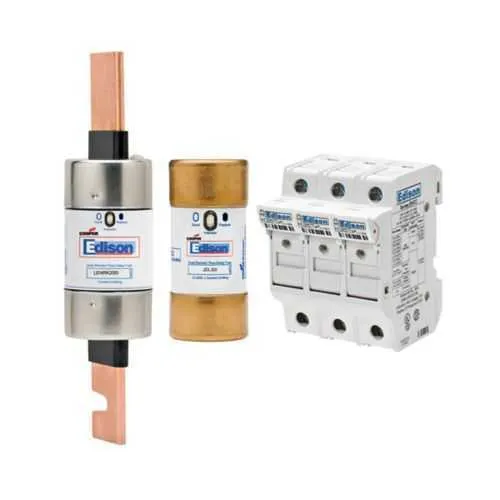
Quick Summary
The Eaton CHSF-350 high speed fuse provides fast, reliable protection for power circuits and motor drives in industrial electrical systems. Engineers often confront nuisance trips from transient faults that cause costly downtime and extended fault isolation. This device carries UL Recognized, CSA Certified, and RoHS Compliant ratings, underscoring safety, regulatory alignment, and supplier trust. For panel builders and system integrators, the bolt-on CHSF-350 delivers robust electrical protection with straightforward installation, supporting compliant procurement and reduced field labor in industrial environments.
Product Information
Extended Description
CHSF-350 Eaton: Eaton Bussmann series CHSF high speed fuse, 500 Vac, 500 Vdc, 350A, 200 kAIC, Non Indicating, High speed fuse, Bolt-on
Product Name
Eaton Bussmann series CHSF high speed fuse
Catalog Number
CHSF-350
UPC
051712534697
Product Length/Depth
0.001 in
Product Height
0.001 in
Product Width
0.001 in
Product Weight
0.001 lb
Warranty
No warranty
Compliances
RoHS Compliant
Certifications
UL Recognized CSA Certified
Amperage Rating
350 A
Interrupt rating
200 kAIC
Voltage rating
500 Vac, 500 Vdc
Packaging type
Standard
Fuse indicator
Non Indicating
Mounting method
Bolt-on
Bussmann series complete full line catalog no. 1007
Bussmann series complete full line catalog no. 1007
Eaton Specification Sheet - CHSF-350
Feature → Business Impact → Application: The CHSF-350’s 350 A amperage rating and 200 kAIC interrupt capacity enable fast fault clearance, reducing arc flash risk and protecting critical equipment, which translates to minimized downtime in heavy machinery and panel boards. This improves uptime and helps meet stringent safety standards during emergencies, particularly in motor drives and power distribution applications. Feature → Business Impact → Application: Bolt-on mounting simplifies field installation and maintenance, lowering commissioning time and labor costs while ensuring secure attachment in compact control panels and switchgear assemblies. Applications span retrofit projects and new builds in industrial automation where space is at a premium. Feature → Business Impact → Application: Non-indicating operation reduces panel clutter and component costs, while leaving fault indication to upstream monitoring systems, ideal for centralized diagnostics in large facilities. Feature → Business Impact → Application: RoHS compliant and UL Recognized/CSA Certified certifications streamline procurement, supplier qualification, and compliance reporting for regulated environments. Feature → Business Impact → Application: The 500 Vac/500 Vdc voltage rating supports both AC and DC power rails, delivering versatile protection across motor drives, feeders, and DC links in mixed-supply systems.
Get a Quick Quote for a Eaton CHSF-350
Chat with us on WhatsApp - fast responses guaranteed
Need to speak with someone? We'll call you back within 2 hours during business hours
Interested in Eaton CHSF-350?
Enquire Now
FAQs
CHSF-350 uses bolt-on mounting, enabling quick, secure installation in standard control panels and switchgear. The bolt-on method reduces commissioning time and simplifies retrofits, while ensuring solid mechanical stability in vibration-prone industrial environments.
CHSF-350 is rated for 350 A with an interrupt rating of 200 kAIC and voltage ratings of 500 Vac and 500 Vdc. During a short-circuit or fault event, it clears the fault quickly to protect downstream equipment and minimize damage and downtime.
Yes. With a 350 A rating, 200 kAIC interrupt capability, and 500 Vac/500 Vdc ratings, CHSF-350 is well-suited for motor drives and DC link protection in industrial automation and power distribution panels.
CHSF-350 is UL Recognized, CSA Certified, and RoHS Compliant. These certifications support regulatory acceptance, supplier qualification, and safer, compliant deployment across industrial facilities and global supply chains.
CHSF-350 is a non-indicating fuse, so visible status is not provided by the device itself; maintenance relies on system monitoring and regular electrical testing. Plan for periodic replacement after fault events or per preventative maintenance schedules, aligned with fault rates and service life of downstream equipment.