
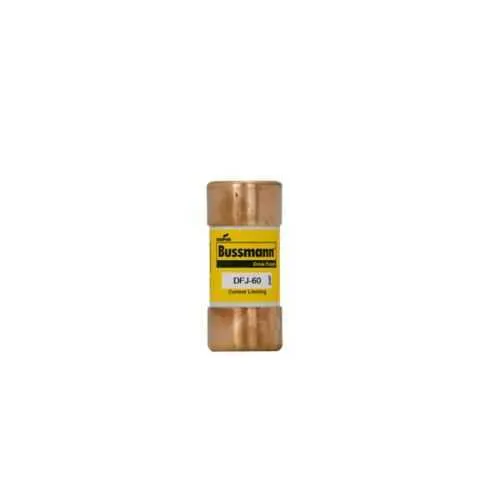
Eaton DFJ-60 High Speed Fuse - UL Listed Class J
Part Number: DFJ-60
Quick Summary
DFJ-60 high speed fuse from Eaton protects motor drives and power panels with fast fault clearance. Engineers often struggle with nuisance trips and downtime when dynamic loads outpace slower fuses. This device carries UL Listed, CSA Certified, and CE RoHS compliant marks, supporting rigorous safety, reliability, and global market access. Designed for Class J applications with a clip-lock connection and a melamine tube, it enables quick installation while delivering predictable, long-lasting protection in harsh industrial environments.
Product Information
Extended Description
DFJ-60 Eaton: Eaton Bussmann series DFJ high speed fuse, 600 Vac or less, 450 Vdc or less, 60A, 200 kAIC at 600 Vac, 100 kAIC 450 Vdc, Non Indicating, High speed fuse, Clip-lock, Class J, Melamine tube
Product Name
Eaton Bussmann series DFJ high speed fuse
Catalog Number
DFJ-60
UPC
051712653374
Product Length/Depth
1 in
Product Height
2.4 in
Product Width
1 in
Product Weight
0.17 lb
Warranty
Not Applicable
Compliances
CE Marked RoHS Compliant
Certifications
UL Listed CSA Certified
Amperage Rating
60 A
Interrupt rating
100 kAIC 450 Vdc 200 kAIC at 600 Vac
Voltage rating
600 Vac or less, 450 Vdc or less
Material
Melamine tube
Packaging type
Standard
Class
Class J
Connection
Clip-lock
Fuse indicator
Non Indicating
Bussmann series complete full line catalog no. 1007
Eaton Specification Sheet - DFJ-60
DFJ-60~DRIVE FUSE
Datasheet - FNQ-30
DFJ-60 delivers fast interruption capability, reducing arc energy and safeguarding downstream equipment, which translates to higher uptime and lower repair costs in drives, panels, and motor control centers. The fuse is rated for 60 A with a voltage ceiling of 600 Vac or less and 450 Vdc or less, offering robust protection for mixed AC/DC control circuits and high-energy faults with 200 kAIC at 600 Vac and 100 kAIC at 450 Vdc. Clip-lock connections and Class J construction simplify installation and ensure secure retention in crowded panels, while the melamine tube provides dependable insulation in demanding environments, contributing to a longer service life and lower maintenance intervals. The DFJ-60 also aligns with UL Listed, CSA Certified, and CE RoHS compliance requirements, supporting global product launches and procurement mandates. Non-indicating design reduces diagnostic clutter during inspections, and standard packaging streamlines stocking and logistics for maintenance teams. In practice, this fuse supports a proactive protection strategy for line-side fusing and motor control circuits, minimizing field returns and warranty risks.
Get a Quick Quote for a Eaton DFJ-60
Chat with us on WhatsApp - fast responses guaranteed
Need to speak with someone? We'll call you back within 2 hours during business hours
Interested in Eaton DFJ-60?
Enquire Now
FAQs
The DFJ-60 is rated for 60 A with a voltage rating up to 600 Vac or 450 Vdc. It provides interrupt ratings of 200 kAIC at 600 Vac and 100 kAIC at 450 Vdc, enabling robust protection for high-energy faults in industrial applications.
The DFJ-60 is UL Listed and CSA Certified, with CE RoHS compliance. These marks support safety compliance, global procurement requirements, and sustainable product stewardship for international projects.
Install the DFJ-60 using its clip-lock connection and Class J form factor. Ensure proper mounting in permitted panel spaces, verify insulation with the melamine tube, and follow the Eaton/Bussmann installation guidance for correct orientation and secure retention.
This fuse excels in motor drives, power distribution panels, and control circuits within industrial environments where fast fault clearance is critical, and mixed AC/DC protection is required. Its high interrupt ratings help protect upstream transformers, drives, and MCCs from damaging faults.
Faster fault clearance reduces downtime and minimizes arc damage, contributing to lower repair costs and improved uptime. UL/CSA compliance reduces regulatory risk, while the durable melamine tube and robust construction extend service life, lowering replacement frequency and overall lifecycle costs.