
Eaton EBR-3Z-2B0GB1-B Bus differential relay - Modbus RTU + DNP3.0 RTU
Part Number: EBR-3Z-2B0GB1-B
Quick Summary
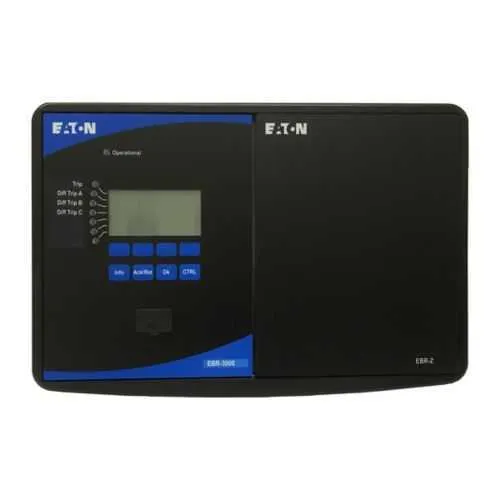
Eaton Bus differential relay is a protection device that monitors feeder currents to detect faults and prevent outages in industrial power distribution. For engineers designing control panels, nuisance trips and slow fault isolation can drive maintenance costs and downtime. This model supports Modbus RTU and DNP3.0 RTU over RS485, with a projection panel mount for compact installations and straightforward retrofits. Compliance details are provided by the manufacturer and should be verified during procurement; the unit includes a wide power-supply range (19-300 Vdc, 40-250 Vac) and a 1-year warranty (or 18 months from shipment, whichever occurs first). The combination of robust digital I/O, field-proven communication options, and panel-friendly form factor delivers measurable business value through improved protection reliability and easier system integration.
Product Information
Extended Description
EBR-3Z-2B0GB1-B Eaton: Eaton, Bus differential relay, EBR-3000, 40-250 Vac, 19-300 Vdc, Bus relay, Modbus RTU + DNP3.0 RTU (RS485 / D-SUB interface), 40-250 Vac, 19-300 Vdc, 8, 6,Feeder19-300Vdc, 40-250Vac, 50/60 Hz, Projection panel mount, -20° to 60°C
Product Name
Eaton Bus differential relay
Catalog Number
EBR-3Z-2B0GB1-B
UPC
786679193792
Product Length/Depth
7.49 in
Product Height
8.62 in
Product Width
13.64 in
Product Weight
12.7 lb
Warranty
Eaton Selling Policy 25-000, one (1) year from the date of installation of the Product or eighteen (18) months from the date of shipment of the Product, whichever occurs first.
Compliances
Contact Manufacturer
Application
Feeder
Type
Bus differential relay
Product Category
Bus relay
Analog inputs
0
Analog outputs
0
Base relay
EBR-3000
Burden
10 W / 17 VA
Conformal coating
Conformal Coated Circuit Boards
Communication
Modbus RTU + DNP3.0 RTU (RS485 / D-SUB interface)
Current sensing inputs
1
Digital inputs
8
Digital outputs
6
Zone selective interlocking
0
Number of inputs
8
Number of outputs
6
Power supply range
19-300Vdc, 40-250Vac
Power consumption
40-250 Vac, 19-300 Vdc
Power supply
40-250 Vac, 19-300 Vdc
Frequency rating
50/60 Hz
Mounting method
Projection panel
Terminals
Removable
Contact Rating
5 A ac / dc
Operating temperature
-20° to 60°C
Voltage sensing inputs
0
Feature → Business Impact → Application: Wide power supply range supports both 19-300 Vdc and 40-250 Vac, enabling deployment across varied regional power formats without multiple SKUs. This reduces inventory complexity and speeds up commissioning in new or refurbished feeder installations. Application: feeders in mixed-volt DC/AC environments, control panels spanning different regions. Feature → Business Impact → Application: Eight digital inputs and six digital outputs provide local interlocking, status feedback, and control signals without external gateways. Result: fewer cables, faster wiring, and improved protection coordination in panel assemblies. Application: feeder protection schemes and panel-mounted control logic. Feature → Business Impact → Application: Modbus RTU plus DNP3.0 RTU over RS485/D-SUB delivers seamless integration with SCADA and PLC ecosystems. Benefit: unified monitoring, faster fault diagnosis, and remote troubleshooting. Application: centralized protection monitoring in industrial plants. Feature → Business Impact → Application: Projection panel mounting simplifies installation and cabinet fit, reducing depth and facilitating retrofits in tight spaces. Benefit: quicker installation and lower labor costs. Application: retrofit projects in existing switchgear cabinets. Feature → Business Impact → Application: 5 A contact rating on outputs ensures reliable signaling for control circuits while maintaining compatibility with standard industrial relays. Benefit: robust interfacing with minimal risk of contact wear. Application: feeder logic and interlock circuits. Additional insights: conformal coating on boards improves reliability in harsh environments; 50/60 Hz operation supports global deployments; 8 digital inputs and 6 outputs enable flexible protection logic without external modules. Application: automation schemes requiring internal IO for local control and status reporting.
Get a Quick Quote for a Eaton EBR-3Z-2B0GB1-B
Chat with us on WhatsApp - fast responses guaranteed
Need to speak with someone? We'll call you back within 2 hours during business hours
Interested in Eaton EBR-3Z-2B0GB1-B?
Enquire Now
FAQs
The unit uses projection panel mounting, designed for compact installations and easy retrofits in standard control cabinets. Its 7.49 in depth and panel-friendly footprint help minimize cabinet intrusion, while still accommodating eight digital inputs and six digital outputs for local control tasks. This makes it practical for upgrading legacy feeders without a full cabinet overhaul.
It supports Modbus RTU and DNP3.0 RTU over RS485 with a D-SUB interface, enabling seamless integration with common SCADA and PLC systems. This reduces integration time, simplifies data collection from feeder protection events, and improves remote diagnostics without additional protocol gateways.
The device accepts 19-300 Vdc and 40-250 Vac, with a frequency rating of 50/60 Hz. It provides a 5 A contact rating on its outputs, and features 8 digital inputs with 6 digital outputs for control signaling. Design considerations should account for these IO counts and the relay’s stated burden (10 W / 17 VA) to ensure proper sizing of power and wiring.
Compliance details are listed as 'Contact Manufacturer' in the data, so certification specifics should be confirmed directly with Eaton or a regional distributor. When procuring, request the latest datasheet and regional certificates (CE, IP ratings, SIL if applicable) to ensure alignment with local electrical standards and safety requirements.
The product is covered by Eaton's standard warranty (one year from installation or eighteen months from shipment, whichever occurs first). For ROI, the fast fault isolation, reduced outage time, and simplified integration with existing protection schemes translate to lower downtime costs and smoother maintenance cycles over the feeder protection lifecycle.