
Eaton EDR-3000-2C1FA0 Distribution Relay - Fiber RTU
Part Number: EDR-3000-2C1FA0
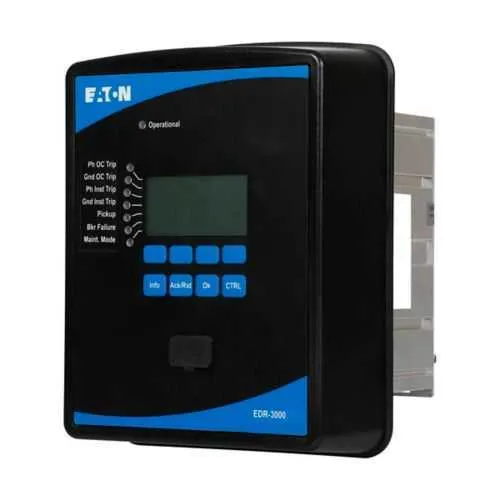
Quick Summary
Eaton distribution relay EDR-3000-2C1FA0 provides precise feeder protection for industrial power systems in demanding environments. Engineers face challenges coordinating protection across multiple feeders while keeping wiring manageable and serviceable. This device supports Modbus RTU or DNP3 RTU over fiber optic, four inputs and four outputs, a broad power-supply range of 19-300 Vdc or 40-250 Vac, and zone-selective interlocking for selective tripping. In practice, that combination reduces downtime, improves protection coordination, and simplifies installation, delivering measurable uptime gains and lower engineering costs for OEMs, utilities, and large plants. Verify compatibility with your control system, confirm required communications, and plan for remote diagnostics to maximize reliability and asset utilization.
Product Information
Extended Description
EDR-3000-2C1FA0 Eaton: Eaton, distribution relay, EDR-3000, Distribution relay, Modbus RTU or DNP3 RTU , 5A, 1A, 40-250 Vac, 19-300 Vdc, 4, 4, Removable, Feeder, 19-300Vdc, 40-250Vac, 50/60 Hz , Sensitive Ground Input,
Product Name
Eaton distribution relay
Catalog Number
EDR-3000-2C1FA0
UPC
786679141359
Product Length/Depth
7.49 in
Product Height
8.62 in
Product Width
6.82 in
Product Weight
5.3 lb
Warranty
Eaton Selling Policy 25-000, one (1) year from the date of installation of the Product or eighteen (18) months from the date of shipment of the Product, whichever occurs first.
Compliances
Contact Manufacturer
Application
Feeder
Type
Distribution relay
Product Category
Distribution relay
Analog inputs
0
Analog outputs
0
Base relay
EDR-3000
Conformal coating
None
Communication
Modbus RTU or DNP3 RTU over Fiber Optic ST
Current sensing inputs
1
I/O options
Sensitive Ground Input IRIG-B
Modbus / DNP3 RTU
over fiber optic ST
Phase current
5A, 1A
Sensing inputs
Current Protection and Metering
Zone selective interlocking
1
Number of inputs
4
Number of outputs
4
Power supply range
19-300Vdc, 40-250Vac
Power consumption
40-250 Vac, 19-300 Vdc
Frequency rating
50/60 Hz
Mounting method
Semi-flush
Terminals
Removable
Voltage sensing inputs
0
E-series protective relays
Programming an Eaton E-Series Relay, Step 2: Getting Started with PowerPort-E
Programming an Eaton E-Series Relay, Step 2: Getting Started with PowerPort-E
Programming an Eaton E-Series Relay, Step 2: Getting Started with PowerPort-E
Programming an Eaton E-Series Relay, Step 2: Getting Started with PowerPort-E
Eaton Specification Sheet - EDR-3000-2C1FA0
Feature → Business Impact → Application: Modbus RTU or DNP3 RTU over fiber optic ST provides robust, interference-free communications, enabling reliable remote monitoring, secure data exchange, and easier integration with SCADA networks for feeder protection across distributed plant segments. Application: ideal for multi-panel industrial plants and utilities where fiber connectivity enhances system visibility and cybersecurity. Feature → Business Impact → Application: Four inputs and four outputs with current sensing inputs enable precise protection and metering, reducing nuisance trips and enabling accurate load monitoring. Application: motor feeders and critical distribution points requiring coordinated trip schemes. Feature → Business Impact → Application: Wide power supply range (19-300 Vdc, 40-250 Vac) and 50/60 Hz operation simplify installation across diverse sites, lowering wiring complexity and inventory needs. Application: retrofits and new builds in plants with mixed power architectures. Feature → Business Impact → Application: Removable terminals and semi-flush mounting streamline wiring, testing, and maintenance, shortening downtime during commissioning and service. Application: field installations with limited access or tight panel spaces. Feature → Business Impact → Application: Sensitive Ground Input IRIG-B timing and zone selective interlocking (1) improve protection selectivity and sequencing, reducing the scope of outages and enabling precise fault isolation. Application: high-reliability feeders in utilities and critical manufacturing lines. Feature → Business Impact → Application: 0 analog inputs/outputs limit complexity while preserving essential protection and metering, ensuring reliable operation without superfluous circuitry. Application: cost-conscious deployments needing essential protection features.
Get a Quick Quote for a Eaton EDR-3000-2C1FA0
Chat with us on WhatsApp - fast responses guaranteed
Need to speak with someone? We'll call you back within 2 hours during business hours
Interested in Eaton EDR-3000-2C1FA0?
Enquire Now
FAQs
Begin by verifying the power supply range (19-300 Vdc or 40-250 Vac) and ensuring the panel supports semi-flush mounting. Connect the four removable terminals, wire the four I/O channels, and configure Modbus RTU or DNP3 RTU over fiber optic ST for communications. Use the 1 current-sensing input to enable protective metering and set zone selective interlocking as required. Plan for IRIG-B timing if synchronization is needed. This approach minimizes wiring changes, speeds commissioning, and simplifies future maintenance.
Key specs include power supply range of 19-300 Vdc or 40-250 Vac, frequency rating of 50/60 Hz, four inputs and four outputs, and current sensing inputs rated at 1 for protection and metering. Communications are via Modbus RTU or DNP3 RTU over fiber optic ST. The device supports zone selective interlocking (1) to improve protection coordination on feeders.
Yes, this relay is designed for feeder protection with integrated metering and protection functions. Its fiber-enabled Modbus/DNP3 communications, flexible power inputs, and zone selective interlocking help coordinate protection across distributed panels, reducing outage duration and enabling faster fault isolation in manufacturing facilities and utility-type plants.
The product data specifies Compliances as 'Contact Manufacturer', so verify with Eaton for CE, UL, or other relevant certifications for your region and application. Also confirm any required IP rating and safety certifications for enclosure and installation environments prior to deployment.
Maintenance benefits come from removableTerminals for easier wiring, straightforward installation, and reliable fiber communications that reduce field troubleshooting. ROI is driven by reduced outage time due to improved selectivity, lower engineer time for wiring and commissioning, and enhanced asset uptime across feeder networks.