
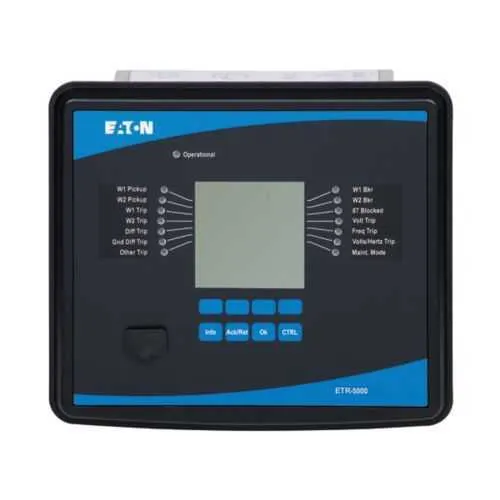
Eaton ETR-4000-2A2IA1 Transformer Relay - 5A/1A
Part Number: ETR-4000-2A2IA1
Quick Summary
Eaton transformer relay is a protection device designed to guard transformer assets in power distribution and OEM equipment. Engineers often struggle with integrating advanced protection logic across RS-485 and Ethernet while maintaining uptime and data visibility. When evaluating protection hardware, verify communications options such as Modbus RTU over RS-485 and Modbus TCP over Ethernet to ensure seamless PLC/SCADA integration. When assessing suitability, verify certifications such as CE marking, SIL readiness, and IP-rated enclosure to match installation and safety requirements. Beyond robust protection logic, this model enables remote diagnostics, flexible power supply compatibility, and easy maintenance, delivering measurable reductions in downtime and operating costs for transformer protection projects.
Product Information
Extended Description
ETR-4000-2A2IA1 Eaton: Eaton, transformer relay, ETR-4000, Transformer protection relay,5A, 1A, 40-250 Vac, 19-300 Vdc, 8, 9,Transformer, over RS-485, over Ethernet RJ-45, 19-300Vdc, 40-250Vac, 50/60 Hz, Projection,Trip Coil Monitor,Sensitive Ground Input,
Product Name
Eaton transformer relay
Catalog Number
ETR-4000-2A2IA1
UPC
786679154151
Product Length/Depth
8.06 in
Product Height
8.7 in
Product Width
9.72 in
Product Weight
9.3 lb
Warranty
Eaton Selling Policy 25-000, one (1) year from the date of installation of the Product or eighteen (18) months from the date of shipment of the Product, whichever occurs first.
Compliances
Contact Manufacturer
Application
Transformer
Type
Transformer relay
Product Category
Transformer protection relay
Analog inputs
0
Analog outputs
0
Base relay
ETR-4000
Conformal coating
None
Current sensing inputs
2
Digital inputs
8
Digital outputs
9
I/O options
IRIG-B Trip Coil Monitor URTD Interface Sensitive Ground Input
Modbus / DNP3 RTU
over RS-485
Modbus / DNP3 TCP
over Ethernet RJ-45
Phase current
5A, 1A
Sensing inputs
Current Protection and Metering Differential Protection
Zone selective interlocking
2
Number of inputs
8
Number of outputs
9
Power supply range
19-300Vdc, 40-250Vac
Frequency rating
50/60 Hz
Power consumption
40-250 Vac, 19-300 Vdc
Number of inputs
8
Number of outputs
9
Power supply range
19-300Vdc, 40-250Vac
Power consumption
40-250 Vac, 19-300 Vdc
Frequency rating
50/60 Hz
Terminals
Removable
Mounting method
Projection
Voltage sensing inputs
0
Terminals
Removable
Power metering, monitoring and diagnostics products for OEMs
Power metering, monitoring and diagnostics products for OEMs
Programming an Eaton E-Series Relay, Step 3: Getting Started with the E-Series Wizard
Programming an Eaton E-Series Relay, Step 3: Getting Started with the E-Series Wizard
Programming an Eaton E-Series Relay, Step 3: Getting Started with the E-Series Wizard
Programming an Eaton E-Series Relay, Step 3: Getting Started with the E-Series Wizard
Programming an Eaton E-Series Relay, Step 3: Getting Started with the E-Series Wizard
Programming an Eaton E-Series Relay, Step 3: Getting Started with the E-Series Wizard
Programming an Eaton E-Series Relay, Step 3: Getting Started with the E-Series Wizard
Eaton Specification Sheet - ETR-4000-2A2IA1
Feature → Business Impact → Application: 8 digital inputs and 9 outputs provide extensive I/O for complex protection schemes, enabling precise transformer fault detection and metering without external modules. This improves system reliability and reduces wiring complexity in substations and OEM panels. Application: transformer protection and control in power distribution networks. Feature → Business Impact → Application: Power supply range of 19-300 VDC and 40-250 VAC across 50/60 Hz minimizes converter needs and simplifies field installations. This lowers capital expenditure and accelerates deployment in mixed electrical environments. Application: retrofit and new install across varied plant voltages. Feature → Business Impact → Application: RS-485 Modbus RTU and Ethernet TCP Modbus provide flexible, standards-based communication for PLCs and SCADA, enabling remote monitoring and coordinated protection strategies. Application: integration with existing control architectures and OT networks. Feature → Business Impact → Application: Removable terminals and projection mounting speed up installation and future maintenance, reducing downtime during upgrades. Application: panel design and serviceability in control rooms and switchgear enclosures. Feature → Business Impact → Application: I/O options including IRIG-B Trip Coil Monitor, URTD Interface, and Sensitive Ground Input enhance fault detection and trip coordination, improving selectivity and safety. Application: high-reliability transformers in critical facilities. Feature → Business Impact → Application: Zone Selective Interlocking 2 supports staged tripping to minimize outage scope, boosting grid resilience and reducing restoration time. Application: utility-scale and industrial transformer protection.
Get a Quick Quote for a Eaton ETR-4000-2A2IA1
Chat with us on WhatsApp - fast responses guaranteed
Need to speak with someone? We'll call you back within 2 hours during business hours
Interested in Eaton ETR-4000-2A2IA1?
Enquire Now
FAQs
This relay uses removable terminals and projection mounting for straightforward panel integration. With 8 digital inputs and 9 outputs, plan I/O routing to minimize cross-wiring. Ensure your supply is within 19-300 VDC or 40-250 VAC and that 50/60 Hz operation is available at the installation site. Compatibility with RS-485 Modbus RTU and Ethernet Modbus TCP supports easy PLC/SCADA integration.
The ETR-4000-2A2IA1 supports Modbus communication in both RTU and TCP variants, enabling flexible data exchange with controllers and SCADA systems. Configure discrete inputs, protection statuses, and metering data via RS-485 for local clusters or Ethernet for remote supervision. This dual-path approach improves diagnostic visibility and reduces commissioning time during deployment.
Yes, the device is designed for transformer protection with features like Zone Selective Interlocking and Trip Coil Monitor options. Its flexible I/O and communications enable coordinated protection schemes. For critical substation use, confirm installation with Eaton to ensure site-specific calibration, safety interlocks, and any required certifications before deployment.
Certification details should be verified directly with Eaton. Typical selections you may encounter include CE marking for European compliance, IP ratings for enclosure protection, and SIL-related features depending on the configuration. Request a current spec sheet and confirmation of applicable certifications for your installation and industry requirements.
The relay offers remote diagnostics, integrated protection logic, and simplified maintenance through removable terminals and standard Modbus communication. By reducing panel trips, enabling faster fault isolation, and improving coordination, users typically see lower downtime costs, longer transformer life, and improved availability in both utility and industrial facilities.