
Eaton ETR-5000-2A1BA0 Transformer Relay - RS485 Modbus
Part Number: ETR-5000-2A1BA0
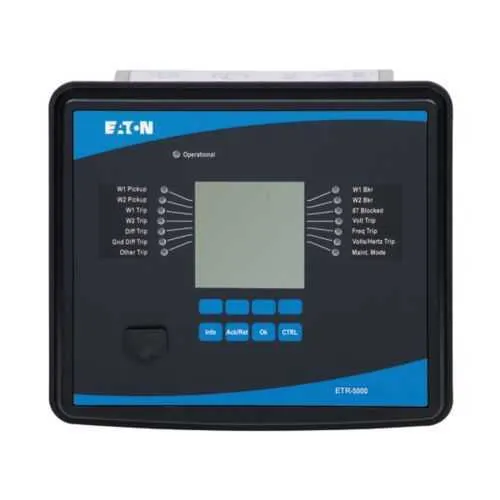
Quick Summary
ETR-5000-2A1BA0 transformer relay provides robust transformer protection and monitoring for feeders in industrial power networks. Engineers often struggle with wiring complexity, protocol integration, and slow fault isolation across distributed control systems. This Eaton relay simplifies integration by supporting Modbus RTU or DNP3 RTU over RS485, while covering a broad power range from 19–300 Vdc and 40–250 Vac at 50/60 Hz. Typical industry standards for these devices include CE compliance for EMC and low voltage directives, RoHS material controls, and safety certs where required—verify per region with Eaton documentation. The unit also offers zone selective interlocking, 8 digital inputs and 9 outputs, and flexible I/O options for reliable alarms and control, driving faster decisions and reduced downtime.
Product Information
Extended Description
ETR-5000-2A1BA0 Eaton: Eaton, transformer relay, ETR-4000, Transformer protection relay, Modbus RTU or DNP3 RTU over RS485, 5A, 1A, 40-250 Vac, 19-300 Vdc, 8, 9,Transformer, over RS-485, 19-300Vdc, 40-250Vac, 50/60 Hz Trip Coil MonitorSensitive Ground Input,
Product Name
Eaton transformer relay
Catalog Number
ETR-5000-2A1BA0
UPC
786679155844
Product Length/Depth
8.06 in
Product Height
8.7 in
Product Width
9.72 in
Product Weight
9.3 lb
Warranty
Eaton Selling Policy 25-000, one (1) year from the date of installation of the Product or eighteen (18) months from the date of shipment of the Product, whichever occurs first.
Compliances
Contact Manufacturer
Application
Transformer
Type
Transformer relay
Product Category
Transformer protection relay
Analog inputs
0
Analog outputs
0
Base relay
ETR-4000
Conformal coating
None
Communication
Modbus RTU or DNP3 RTU over RS485
Current sensing inputs
2
Digital inputs
8
Digital outputs
9
I/O options
Trip Coil Monitor URTD Interface IRIG-B Sensitive Ground Input
Modbus / DNP3 RTU
over RS-485
Phase current
5A, 1A
Sensing inputs
Voltage Protection and Metering Differential Protection Power Protection and Metering Current Protection and Metering
Zone selective interlocking
2
Number of inputs
8
Number of outputs
9
Power supply range
19-300Vdc, 40-250Vac
Frequency rating
50/60 Hz
Power consumption
40-250 Vac, 19-300 Vdc
Number of inputs
8
Number of outputs
9
Power supply range
19-300Vdc, 40-250Vac
Power consumption
40-250 Vac, 19-300 Vdc
Frequency rating
50/60 Hz
Terminals
Removable
Mounting method
Semi-flush
Voltage sensing inputs
1
Terminals
Removable
E-series protective relays
E-series protective relays
Programming an Eaton E-Series Relay, Step 4: Advanced Configuration with PowerPort-E
Programming an Eaton E-Series Relay, Step 4: Advanced Configuration with PowerPort-E
Programming an Eaton E-Series Relay, Step 4: Advanced Configuration with PowerPort-E
Programming an Eaton E-Series Relay, Step 4: Advanced Configuration with PowerPort-E
Programming an Eaton E-Series Relay, Step 4: Advanced Configuration with PowerPort-E
Programming an Eaton E-Series Relay, Step 4: Advanced Configuration with PowerPort-E
Programming an Eaton E-Series Relay, Step 4: Advanced Configuration with PowerPort-E
Eaton Specification Sheet - ETR-5000-2A1BA0
Eight digital inputs, nine digital outputs, and two current-sensing inputs provide a compact protection hub for transformers. This integrated I/O reduces panel wiring, lowers installation errors, and centralizes alarm signaling. In practice, teams can deploy coordinated protections with fewer components, speeding commissioning and improving fault responsiveness across critical transformer assets. Communication is built around Modbus RTU or DNP3 RTU over RS485, enabling seamless PLC/SCADA integration, centralized logging, and remote configuration. This capability reduces field visits, accelerates troubleshooting, and supports scalable protection schemes across distributed assets. Power supply range covers 19–300 Vdc and 40–250 Vac at 50/60 Hz, offering flexible operation from diverse plant power sources. That flexibility simplifies retrofits and back-compatibility with existing equipment, while reducing the need for multiple adapters. I/O options include Trip Coil Monitor, URTD Interface, IRIG-B timing, and Sensitive Ground Input; zone selective interlocking with two inputs enhances selectivity, mitigates nuisance trips, and minimizes outage duration. Finally, removable terminals and semi-flush mounting speed installation, and compatibility with the ETR-4000 base relay provides a straightforward upgrade path, ensuring a consistent protection platform across substations and industrial facilities.
Get a Quick Quote for a Eaton ETR-5000-2A1BA0
Chat with us on WhatsApp - fast responses guaranteed
Need to speak with someone? We'll call you back within 2 hours during business hours
Interested in Eaton ETR-5000-2A1BA0?
Enquire Now
FAQs
The ETR-5000-2A1BA0 uses Modbus RTU or DNP3 RTU over RS485, enabling direct communication with common PLCs and SCADA platforms. This integration supports centralized alarms, event logging, and remote configuration, reducing field trips and shortening fault isolation times. The 8 digital inputs and 9 outputs provide ample I/O for coordinated protection schemes, while removable terminals simplify the wiring during retrofit or new installation.
Key specifications include a power supply range of 19–300 Vdc and 40–250 Vac at 50/60 Hz, 8 digital inputs, 9 digital outputs, and 2 current-sensing inputs. The device supports 50/60 Hz operation, RS485 communications with Modbus RTU or DNP3 RTU, and a base relay platform (ETR-4000). It also offers optional timing and protection features such as IRIG-B timing and Trip Coil Monitoring for enhanced synchronization and protection accuracy.
Yes. The ETR-5000-2A1BA0 is designed for transformer protection in both substations and industrial facilities. It supports zone selective interlocking, multiple protection metering and protection schemes, and a flexible I/O set to align with substation protection philosophies. Its RS485 communication enables integration with centralized protection schemes, while the broad voltage range supports diverse plant electrical architectures.
Compliances are typically aligned with regional requirements such as CE for EMC and low-voltage directives and RoHS material controls. Exact certifications should be confirmed in Eaton’s official documentation or the product specification sheet for your region. This ensures you meet local safety, electromagnetic compatibility, and environmental standards relevant to transformer protection relays.
The ETR-5000-2A1BA0 consolidates protection, monitoring, and control into a single unit, reducing panel space and wiring complexity. Its remote communication capability lowers maintenance trips by enabling centralized diagnostics, while robust fault signaling and zone selective interlocking shorten outage durations. Over time, this can translate to lower total cost of ownership through faster fault resolution, reduced unplanned downtime, and streamlined spare-part management.