
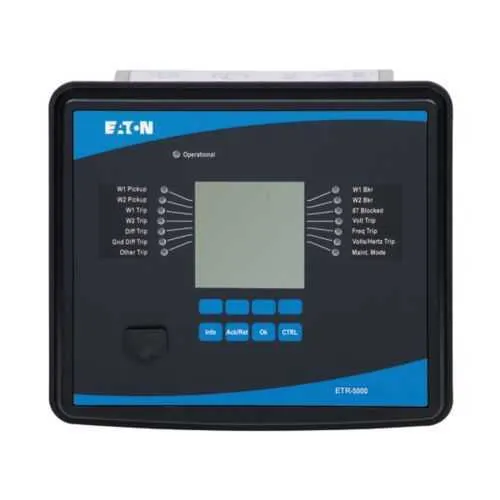
Eaton Transformer Relay ETR-5000-2A2DB1 - Profibus-DP over Fiber
Part Number: ETR-5000-2A2DB1
Quick Summary
The Eaton transformer relay protects transformer circuits by monitoring conditions and communicating status for industrial automation control. Installation and network integration can be complex, especially when aligning protection logic with modern control systems. Certification details such as CE, SIL, and IP ratings are model-dependent; verify exact approvals with Eaton for this configuration. By combining Profibus-DP connectivity with robust protection features, the ETR-5000-2A2DB1 helps reduce downtime and streamline procurement, while enabling reliable data exchange in protection schemes and OT/IT convergence. This makes it a strong fit for transformer protection in manufacturing, power distribution, and process industries, supporting broader plant-wide reliability and traceability.
Product Information
Extended Description
ETR-5000-2A2DB1 Eaton: Eaton transformer relay, Profibus-DP , 5A, 1A, 40-250 Vac, 19-300 Vdc, 8, 9,Transformer, 19-300Vdc, 40-250Vac, 50/60 Hz, Projection, IRIG-B, Trip Coil Monitor, Sensitive Ground Input, URTD Interface
Product Name
Eaton transformer relay
Catalog Number
ETR-5000-2A2DB1
UPC
786679156315
Product Length/Depth
8.06 in
Product Height
8.7 in
Product Width
9.72 in
Product Weight
9.3 lb
Warranty
Eaton Selling Policy 25-000, one (1) year from the date of installation of the Product or eighteen (18) months from the date of shipment of the Product, whichever occurs first.
Compliances
Contact Manufacturer
Application
Transformer
Type
Transformer relay
Product Category
Transformer protection relay
Analog inputs
0
Analog outputs
0
Base relay
ETR-4000
Conformal coating
Conformal Coated Circuit Boards
Communication
Profibus-DP over Fiber Optic ST
Current sensing inputs
2
Digital inputs
8
Digital outputs
9
I/O options
IRIG-B URTD Interface Sensitive Ground Input Trip Coil Monitor
Phase current
5A, 1A
PROFIBUS-DP
over fiber optic ST
Sensing inputs
Voltage Protection and Metering Differential Protection Current Protection and Metering Power Protection and Metering
Zone selective interlocking
2
Number of inputs
8
Number of outputs
9
Power supply range
19-300Vdc, 40-250Vac
Frequency rating
50/60 Hz
Power consumption
40-250 Vac, 19-300 Vdc
Number of inputs
8
Number of outputs
9
Power supply range
19-300Vdc, 40-250Vac
Power consumption
40-250 Vac, 19-300 Vdc
Frequency rating
50/60 Hz
Terminals
Removable
Mounting method
Projection
Voltage sensing inputs
1
Terminals
Removable
E-series protective relays
E-series protective relays
Introduction to Eaton's E-Series Relay, Step 1: Physical Connections
Introduction to Eaton's E-Series Relay, Step 1: Physical Connections
Introduction to Eaton's E-Series Relay, Step 1: Physical Connections
Introduction to Eaton's E-Series Relay, Step 1: Physical Connections
Introduction to Eaton's E-Series Relay, Step 1: Physical Connections
Introduction to Eaton's E-Series Relay, Step 1: Physical Connections
Introduction to Eaton's E-Series Relay, Step 1: Physical Connections
Eaton Specification Sheet - ETR-5000-2A2DB1
Feature → Business Impact → Application: 8 digital inputs and 9 digital outputs enable comprehensive protection logic and signaling within a single device, reducing panel footprint and improving fault visibility at the device level for transformer protection in substations and control rooms. This translates to faster fault isolation and easier maintenance planning; ideal for retrofit projects where ETR-4000 base compatibility is required. Feature → Business Impact → Application: Power supply range of 19-300 Vdc and 40-250 Vac at 50/60 Hz, with removable terminals and projection mounting, simplifies installation and retrofit into existing enclosures, reducing commissioning time and hardware fatigue in industrial environments. Feature → Business Impact → Application: Profibus-DP over fiber optic ST provides EMI-resistant, high-integrity communication for remote monitoring and control across harsh factory floors, supporting scalable automation architectures like DCS/SCADA integration. Feature → Business Impact → Application: I/O options including IRIG-B URTD Interface, Sensitive Ground Input, and Trip Coil Monitor deliver enhanced fault signaling and protection accuracy, enabling precise coordination in zone-selective interlocking (2), which reduces unnecessary trips and improves system reliability. Feature → Business Impact → Application: Conformal coating and rugged construction protect circuit boards in challenging environments, lowering maintenance frequency and total cost of ownership for transformer protection relays in outdoor substations and harsh manufacturing settings. Feature → Business Impact → Application: Compatibility with the ETR-4000 base and 2A/5A current sensing inputs supports modular upgrades and seamless replacement in legacy protection schemes, reducing migration risk and enabling phased system upgrades. Feature → Business Impact → Application: Comprehensive protection metering options (Voltage, Differential, Current, and Power metering) support accurate monitoring and reporting, enabling better energy management and compliance documentation for process industries and energy-intensive applications.
Get a Quick Quote for a Eaton ETR-5000-2A2DB1
Chat with us on WhatsApp - fast responses guaranteed
Need to speak with someone? We'll call you back within 2 hours during business hours
Interested in Eaton ETR-5000-2A2DB1?
Enquire Now
FAQs
Plan for 8 digital inputs and 9 outputs, removable terminals for easy maintenance, and projection mounting. Ensure power supply within 19-300Vdc or 40-250Vac, 50/60 Hz, and confirm Profibus-DP fiber connectivity compatibility with your network architecture.
Note 8 inputs, 9 outputs, phase currents at 5A and 1A, +/− voltage sensing inputs, and a power range of 19-300Vdc / 40-250Vac. Verify URTD/IRIG-B interfaces and Trip Coil Monitor for accurate fault signaling and coordination with zone selective interlocking (2).
Yes, it supports Profibus-DP over fiber optic ST, designed for EMI resistance and reliable data transmission in industrial settings. Confirm installation with appropriate fiber optic cabling and network topology to maximize performance.
Certification details are model-dependent. CE, SIL, and IP ratings are common in industry, but verify the exact approvals for this configuration with Eaton’s technical support or datasheets before purchase.
Conformal coating, rugged construction, and modular base compatibility reduce maintenance down-time and spare-part complexity. The integrated protection and signaling capabilities can lower downtime costs by enabling faster fault isolation and improved network integration.