
Eaton GUAD260 conduit outlet - Hazardous/Classified Locations
Part Number: GUAD260
Quick Summary
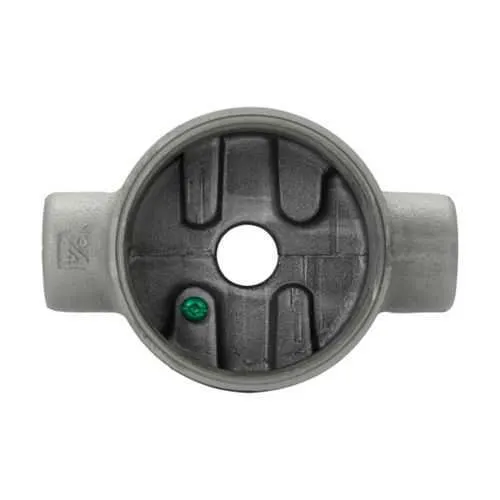
Eaton GUAD260 conduit outlet is a rugged, explosion-protected component designed for hazardous-location installations in industrial facilities. Many projects struggle with bulky fittings that complicate installation, require special tooling, and slow maintenance. This unit delivers NEC/CEC compliance and robust Class I, Division 1 & 2, Class II, and Class III ratings, ensuring safe operation across demanding environments. The design supports standard footprints and hanger-cover compatibility, helping installers achieve faster pull-through and easier retrofits. By combining durable materials with reliable sealing, it reduces downtime and lifecycle costs, while enabling straightforward inspections and ongoing regulatory compliance. OEMs, integrators, and maintenance teams gain a scalable, dependable protection solution.
Product Information
Extended Description
GUAD260 Eaton: Eaton Crouse-Hinds series GUA conduit outlet body, Feraloy iron alloy, D shape, 3/4"
Product Name
Eaton Crouse-Hinds series GUA conduit outlet body
Catalog Number
GUAD260
UPC
782274796345
Product Length/Depth
5.25 in
Product Height
3.5 in
Product Width
2.88 in
Product Weight
2.12 lb
Area classification
Hazardous/Classified Locations
Standards type
NEC/CEC
NEC hazardous rating
Class I, Division 1 Class I, Division 2 Class II, Division 1 Class II, Division 2 Class III
Shape
D
Trade size
3/4"
Material
Feraloy iron alloy
Crouse-Hinds series GUA Explosionproof Conduit Outlet Boxes with Hanger Covers catalog page
GUA Explosionproof Conduit Outlet Boxes with Hanger Covers UL certification
Eaton Specification Sheet - GUAD260
Feraloy iron alloy body delivers rugged strength and superior heat and impact resistance, essential for explosions and chemical exposure. The D-shaped profile in a 3/4" trade size streamlines conduit connections, supporting consistent threading and secure sealing. Compact footprint with 5.25 in length, 3.5 in height, and 2.88 in width (2.12 lb) enables tighter layouts and easier handling during installation. NEC/CEC certification with Class I Division 1 & 2; Class II Division 1 & 2; Class III ensures compliance across hazardous locations, reducing regulatory risk and rework. Hanger-cover compatibility and GUA series ecosystem simplify mounting and maintenance, lowering field fabrication time and total cost of ownership. Access to Eaton specification sheets and UL certification supports informed procurement, faster validation, and long-term reliability in demanding plants.
Get a Quick Quote for a Eaton GUAD260
Chat with us on WhatsApp - fast responses guaranteed
Need to speak with someone? We'll call you back within 2 hours during business hours
Interested in Eaton GUAD260?
Enquire Now
FAQs
Installers should verify Class I, Division 1 or 2 and Class II/III ratings per NEC/CEC, ensure proper enclosure grounding, and use hanger covers compatible with the GUA series. The 5.25 in x 3.5 in x 2.88 in footprint fits common hazardous-area layouts, enabling secure conduit connections without compromising protection.
GUAD260 carries NEC/CEC standards with hazardous-location ratings: Class I Division 1 & 2, Class II Division 1 & 2, and Class III. These certifications confirm suitability for explosive atmospheres, aiding compliance, project approvals, and safe operation across oil, gas, chemical, and mining environments.
Yes. The GUAD260 is designed for hanger-cover compatibility within Eaton Crouse-Hinds GUA series applications, enabling quicker mounting, streamlined retrofits, and reduced field fabrication—benefiting maintenance schedules and uptime guarantees.
The conduit outlet body measures 5.25 in in length, 3.5 in in height, and 2.88 in in width, with a weight of 2.12 lb. The 3/4" trade size and D-shaped form support standard conduit connections in compact installations.
GUAD260 suits hazardous-location installations in oil & gas, chemical processing, and mining where explosion protection and reliable ongoing performance are required. Benefits include regulatory compliance, reduced maintenance downtime, and faster installation with compatible hanger covers, delivering lower total cost of ownership over the equipment life cycle.