
Eaton KCD-V Cable Limiter - 200 kAIC Rating for 600V
Part Number: KCD-V
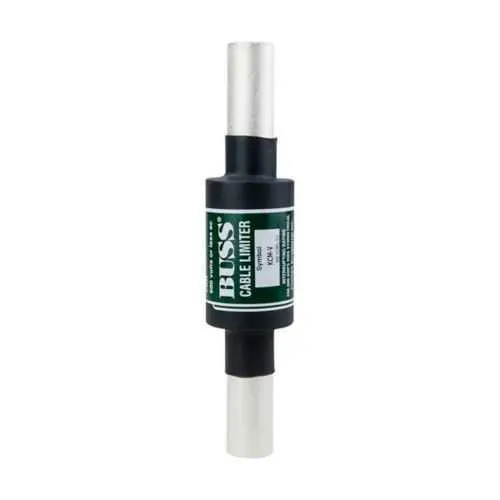
Quick Summary
The Eaton KCD-V cable limiter acts as a high-energy protective device for copper conductors in industrial power distribution. In the field, sudden surges and fault currents can derail uptime, complicating fault tracing and repair. The device delivers a 200 kAIC interrupt rating at 600 V and is RoHS compliant, supporting safe, regulatory-compliant installations. With copper #2/0 AWG conductors and a shrink-tube feature, it integrates smoothly into existing wiring practices, reducing lead times and total cost of ownership. Engineers value its non-indicating design that minimizes nuisance alarms while maintaining critical protection in control panels, switchgear, and bus-duct installations. Designed for Eaton's Bussmann series lineup, it offers predictable performance, easier stocking, and clearer procurement for engineering teams.
Product Information
Extended Description
KCD-V Eaton: Eaton Bussmann series KCD cable limiter, 200 kAIC, Cable: copper, 2/0 AWG, Non indicating, V
Product Name
Eaton Bussmann series KCD cable limiter
Catalog Number
KCD-V
UPC
051712177023
Product Length/Depth
1.25 in
Product Height
5.885 in
Product Width
1.25 in
Product Weight
0.1 lb
Warranty
Not Applicable
Compliances
RoHS Compliant
Interrupt rating
200 kAIC
Voltage rating
600 V
Material
Cable: Copper
Wire size
#2/0 AWG
Fuse indicator
Non-indicating
Special features
With shrink tube
KCD-V~BUSS CABLE LIMITER
KCD-V~BUSS CABLE LIMITER
Bussmann series Fuseology
Eaton Specification Sheet - KCD-V
Feature → Business Impact → Application The KCD-V uses a 200 kAIC interrupt rating at 600 V, delivering robust fault interruption that lowers downtime and protects downstream equipment. This translates to higher system availability in critical power distribution scenarios, such as motor control centers and bus ducts, where fast fault clearance minimizes production losses. Copper construction paired with a #2/0 AWG wire size ensures reliable conductor compatibility and durable field service, useful in harsh industrial environments and retrofit projects. The non-indicating fuse indicator reduces nuisance alarms, while the shrink tube enhances insulation integrity during installation and long-term operation, lowering maintenance callbacks and safety concerns. Its RoHS compliance supports regulatory alignment in modern facilities, simplifying procurement and supplier audits. The KCD-V plugs into existing Bussmann catalog lines, enabling seamless stocking and quicker project execution in panel builds and electrical cabinets.
Get a Quick Quote for a Eaton KCD-V
Chat with us on WhatsApp - fast responses guaranteed
Need to speak with someone? We'll call you back within 2 hours during business hours
Interested in Eaton KCD-V?
Enquire Now
FAQs
To install the KCD-V, verify conductor size is #2/0 AWG copper and prepare space for the 1.25 in depth and 1.25 in width footprint. Use the shrink tube feature to seal and insulate the splice areas. Since it is non-indicating, plan for external fault tracing methods (tools, schematics) to confirm fault location post-arrest. Ensure RoHS compliance documentation is on hand for audits.
The 200 kAIC interrupt rating indicates the device can safely interrupt very high fault currents without sustaining damage, which protects downstream equipment and reduces the risk of cascading failures. This is critical in heavy industrial environments with high fault current potential, such as main feeders and MCCs, delivering improved uptime and safety margins.
Yes. The KCD-V is rated for 600 V, making it suitable for many 600 V distribution architectures found in North America and select international installations. It features copper #2/0 AWG conductors and RoHS compliance, supporting regulatory alignment in global facilities while maintaining compatibility with Eaton Bussmann catalog components.
The KCD-V reduces downtime by enabling faster fault interruption and clearer fault paths, which shortens repair cycles. Its robust copper construction and shrink-tube insulation minimize field return visits, while RoHS compliance streamlines audits and procurement. Overall, you gain lower maintenance costs, fewer spare-part SKUs, and faster project completion in new builds or upgrades.
Expect space constraints around dense panel layouts; plan for the 1.25 in depth, 1.25 in width footprint, and ensure there is enough clearance for the shrink-tube installation. Since the unit is non-indicating, prepare non-invasive fault-location methods and keep the catalog and UPC documentation handy for asset management and warranty verifications.