
Eaton LPS-RK-17-1/2SPI Fuse - CE Marked RK1 Class
Part Number: LPS-RK-17-1/2SPI
Quick Summary
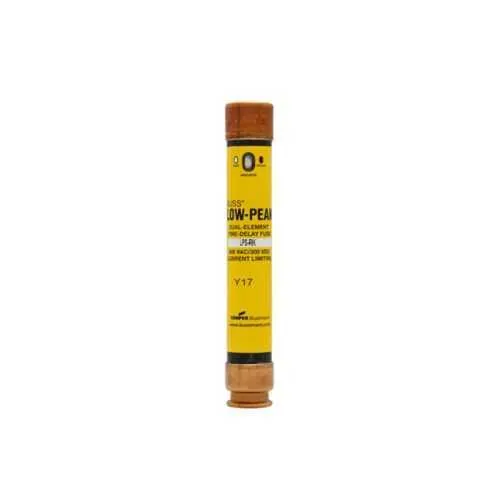
Eaton LPS-RK fuse provides time-delay, current-limiting protection for motor drives and control panels. Operators often face nuisance trips from brief surges that disrupt critical production cycles. This device is CE marked and designed to meet Class RK1 standards, delivering 600 Vac operation with 300 kAIC interrupt capability for robust protection in demanding environments. The 17.5 A rating aligns with common protection schemes in industrial equipment, while its dual-element construction enhances selectivity and arc quenching. With a compact 5 in length and standard packaging, it installs easily in existing panel spaces, supporting reliable protection without costly redesigns.
Product Information
Extended Description
LPS-RK-17-1/2SPI Eaton: Eaton Bussmann Series Class RK1 fuse, LPS-RK, time-delay, dual-element, current limiting fuse, 17.5 A, indicating fuse, interrupting rating of 300 kA at 600 Vac
Product Name
Eaton Bussmann series LPS-RK fuse
Catalog Number
LPS-RK-17-1/2SPI
UPC
051712626903
Product Length/Depth
5 in
Product Height
0.81 in
Product Width
0.81 in
Product Weight
1.6 lb
Warranty
Not Applicable
Compliances
CE Marked
Amperage Rating
17.5 A
Interrupt rating
300 kAIC at 600 Vac 100 kAIC at 300 Vdc
Response time
10 sec at 500%
Voltage rating
600 Vac, 300 Vdc
Fuse type
Time delay Current-limiting
Number of elements
Dual
Packaging type
Standard
Class
Class RK1
Fuse indicator
Non-indicating With Indicator
Quantity
10
Low Voltage Branch Circuit Fuse Chapter
Low Voltage Branch Circuit Fuse Chapter
RoHS Search Tool
Bussmann series Fuseology
Bussmann series Low-Peak 600 V LPS Class RK1 time-delay fuses, up to 600 A data sheet no. 1001
Time-delay dual-element design provides both rapid fault interruption and surge tolerance, enabling safer, more predictable electrical protection for motor drives, heavy machinery, and protective control panels in challenging industrial environments. This combination improves selectivity by allowing brief transients to pass without tripping, while still shutting down sustained faults that threaten equipment, causing unplanned outages and costly downtime. In industrial control panels, compact footprints and compatibility with RK1 class devices simplify retrofits, while CE compliance and 600 Vac capability support broad integration across OEM builds. Current-limiting capability confines fault current to downstream components during faults, preserving wiring insulation, protecting contactors, relays, and sensitive electronics from damaging surge energy. With a 300 kAIC interrupt rating at 600 Vac, upstream breakers and feeders stay within safe margins, enhancing personnel safety, minimizing arc flash exposure, and improving overall system reliability. That performance translates to fewer component failures, quicker fault isolation during maintenance, and more predictable mean time between failures across production lines. The 17.5 A amperage rating aligns with common protection schemes for small to mid-size industrial loads, enabling straightforward cross-reference with existing panels and engineering standards. 600 Vac and 300 Vdc voltage ratings cover primary and auxiliary circuits in most control systems, reducing the need for adapters or multiple fuse types during upgrades. These specifications simplify bills of materials, shorten engineering cycles in OEM projects, and support scalable protection as equipment capacity grows. Physical form factor supports fast, drop-in replacement in RK1 basings, holders, and standard enclosures, minimizing downtime during servicing and spare parts management. Five-inch length and 0.81 inch width and height match typical Bussmann RK1 footprints, allowing straightforward field replacements without custom enclosures. Packaging of ten per order streamlines stocking for maintenance teams, procurement workflows, and site-wide consistency across multiple machines. CE marking demonstrates regulatory alignment for European and global installations, while RK1 classification confirms proper coordination within cascaded protection schemes and standards. Comprehensive catalogs and data sheets, including the Low Voltage Branch Circuit Fuse chapters, support formal approvals, training, and engineering sign-offs. Availability of indicator options and variations, plus standard versus indicator variants, aids condition monitoring, remote fault reporting, and asset health programs.
Get a Quick Quote for a Eaton LPS-RK-17-1/2SPI
Chat with us on WhatsApp - fast responses guaranteed
Need to speak with someone? We'll call you back within 2 hours during business hours
Interested in Eaton LPS-RK-17-1/2SPI?
Enquire Now
FAQs
When selecting this fuse, verify compatibility with RK1 basings and standard enclosures, note the five-inch length and 0.81 inch cross-section for fit, and plan for standard packaging of ten units per order to simplify stocking and replacements across multiple panels.
The 600 Vac rating covers typical industrial mains, while the 300 kAIC interrupt rating ensures rapid fault clearance without exceeding equipment insulation limits. This combination reduces downstream damage, improves safety margins, and supports coordination with upstream protective devices in power distribution schemes.
Best suited for industrial control panels, motor drives, and machine enclosures where reliable time-delay protection and current limiting are required. Its RK1 class and CE marking make it a strong fit for OEM retrofits and new equipment in European and global markets.
Engineers should consult the Low Voltage Branch Circuit Fuse catalogs and datasheets for LPS-RK products, including data sheet 1001 where applicable. CE marking and RK1 classification are noted, aiding formal approvals and regulatory reviews during project sign-off.
The time-delay, dual-element design reduces nuisance trips, supporting higher uptime. The 10‑piece packaging and standard form factor simplify stocking, procurement, and field replacements, delivering lower maintenance costs and faster maintenance cycles across industrial sites.