
Eaton N48M28B7516 Transformer - K-Factor 13
Part Number: N48M28B7516
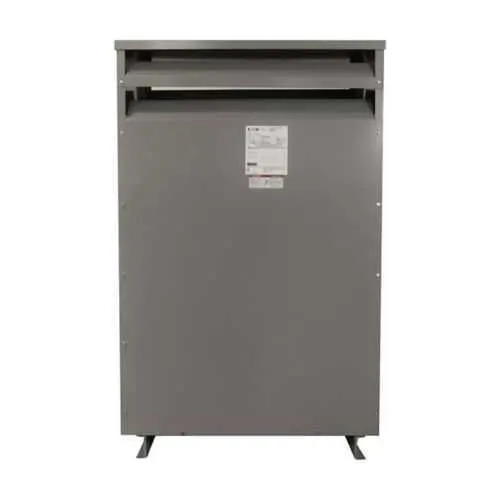
Quick Summary
The Eaton N48M28B7516 transformer provides efficient, three-phase power distribution for industrial automation and critical loads. Engineers often face heat, energy waste, and regulatory compliance challenges when scaling power for growing facilities. UL Listed, 10 CFR Part 431 DOE 2016 efficiency, and a NEMA 2 enclosure reinforce reliability in harsh environments. The K-Factor 13 profile, electrostatic shield, and WS60 weather shield help manage harmonics and weather exposure, while the FR943 frame supports robust installation. For manufacturers integrating 480 V to 208Y/120 V loads, this dry-type transformer aligns with DOE efficiency goals and lifecycle cost reduction. This model also offers flexible mounting options and industry-standard connections to streamline procurement and service.
Product Information
Extended Description
N48M28B7516 Eaton: Eaton Eaton K-Factor nonlinear ventilated transformer, Aluminum windings, NEMA 2, FR943, 60 Hz, 220°C, 75 kVA , Three-phase, 480 Delta V, 208Y/120 Vac, NEMA ST-20, 80°C, 75 kVA, 480 Vac-208Y/120 Vac, WS60, 283B, DOE 2016
Product Name
Eaton K-Factor nonlinear ventilated transformer
Catalog Number
N48M28B7516
UPC
786680191886
Product Length/Depth
31.5 in
Product Height
51 in
Product Width
34.5 in
Product Weight
1237 lb
Warranty
Eaton Selling Policy 25-000, one (1) year from the date of installation of the Product or eighteen (18) months from the date of shipment of the Product, whichever occurs first.
Certifications
UL Listed
Catalog Notes
10 CFR Part 431 (2016) Efficient
Coil material
Aluminum
Enclosure
NEMA 2
Wiring connection
283B
Type
Energy-efficient ventilated transformer
Frame
FR943
Insulation
220 °C
Mounting
Floor or wall
Tap size
2 at +2.5%, 4 at -2.5%
Frequency rating
60 Hz
Kva Rating
75 kVA
Volt ampere rating
75 kVA
Phase
Three-phase
Primary voltage
480 V
Secondary Voltage
208Y/120 V
Sound Level
NEMA ST-20
Temperature rise
80 °C rise
Voltage rating
480 Vac-208Y/120 Vac
Efficiency
10 CFR Part 431-2016 (DOE 2016)
Modification 1
Electrostatic shield
Special features
K-factor 13
Weathershield
WS60
Eaton's high-efficiency dry-type transformers
Eaton's high-efficiency dry-type transformers
Eaton's Transformer Flex Center
Eaton Specification Sheet - N48M28B7516
Feature → Business Impact → Application: The K-Factor nonlinear ventilated design with aluminum windings and 220 °C insulation (FR943 frame) improves harmonic resilience and thermal tolerance, reducing overheating risk and maintenance costs while enabling reliable operation in challenging environments. Application: harmonic-rich industrial cells and automation lines needing stable voltage under fluctuating loads. Feature → Business Impact → Application: NEMA 2 indoor enclosure with floor or wall mounting and WS60 weather shield provides robust protection and installation flexibility, lowering enclosure cooling requirements and enabling cleaner layouts on factory floors. Application: manufacturing plants and control rooms requiring adaptable mounting and enhanced protection. Feature → Business Impact → Application: Tap size options of 2 at +2.5% and 4 at -2.5% enable precise voltage regulation under load, minimizing voltage drop and protecting sensitive equipment. Application: motors, drives, and PLC-based systems with tight voltage tolerance. Feature → Business Impact → Application: 480 V primary to 208Y/120 V secondary in a three-phase 60 Hz system delivers compatibility with common facility power, reducing wiring complexity and upgrading paths. Application: retrofits and new builds in process plants. Feature → Business Impact → Application: Electrostatic shield enhances short-circuit resilience and EMI suppression, improving control-system reliability and noise performance. Application: robotics and automation lines with strict signal integrity requirements. Feature → Business Impact → Application: DOE 2016 energy efficiency compliance and a 75 kVA rating reduce idle losses and operating costs, supporting sustainability targets and lower total cost of ownership. Application: facilities pursuing energy reduction programs and longer service life for critical loads.
Get a Quick Quote for a Eaton N48M28B7516
Chat with us on WhatsApp - fast responses guaranteed
Need to speak with someone? We'll call you back within 2 hours during business hours
Interested in Eaton N48M28B7516?
Enquire Now
FAQs
Install on a stable floor or wall mount in a dry, indoor space per NEMA 2 enclosure guidance. Connect primary to 480 V (delta) using 283B wiring, then connect secondary to 208Y/120 V circuits. Use the tap settings (2 at +2.5%, 4 at -2.5%) to fine-tune voltage under load. Verify proper clearance, ventilation, and grounding, and follow UL and manufacturer installation manuals for safe startup.
K-Factor 13 indicates enhanced resistance to harmonic heating from nonlinear loads. This reduces transformer overheating, extends service life, and stabilizes voltage under harmonic stress. In practice, facilities with drives, welders, and other non‑linear loads experience fewer temperature excursions and lower maintenance costs, while meeting EMI/EMC expectations for industrial controls.
Yes. The NEMA 2 enclosure is designed for indoor dry locations, and the WS60 weather shield adds extra protection in semi-dry areas. Its rigid FR943 frame, aluminum windings, and 80 °C rise rating support reliable operation in harsh factory environments, making it a solid choice for production lines, automation cabinets, and control rooms.
The unit is UL Listed for safety and compliance. It also aligns with DOE 2016 efficiency requirements under 10 CFR Part 431, helping reduce energy waste. The transformer’s design includes an electrostatic shield and a NEMA 2 enclosure, with a 75 kVA rating suitable for regulated industrial applications and performance predictability.
ROI is driven by reduced idle losses from DOE 2016 efficiency, lower energy waste, and improved voltage stabilization under harmonic loads. The 75 kVA rating supports larger or more reliable loads without oversizing, while durable construction and reduced maintenance burden lower lifecycle costs. A formal ROI calculation should consider facility load profile, energy rates, and maintenance savings over the transformer’s life.