
Eaton N48M35F22EE Transformer - K-Factor Nonlinear
Part Number: N48M35F22EE
Quick Summary
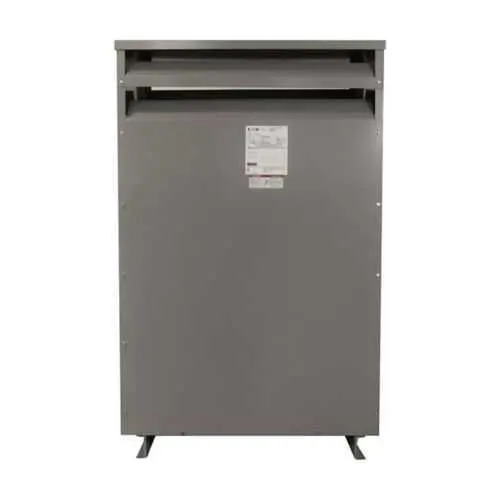
Eaton N48M35F22EE Transformer is a K-Factor nonlinear ventilated transformer for industrial power distribution. This design addresses heat buildup and harmonic stress that can raise cooling costs and shorten equipment life. Certifications vary by region; typical industry marks include CE and UL/CSA, though this model lists Certification as 'Contact Manufacturer' and regional validation applies. The 225 kVA rating with 480 V primary and 440Y/254 V secondary supports reliable power delivery in manufacturing lines and data centers while enabling straightforward integration with standard low-voltage distribution schemes. In practice, this transformer can improve uptime, reduce energy losses, and align with procurement goals for total cost of ownership and long-term reliability.
Product Information
Extended Description
N48M35F22EE Eaton: Eaton K-Factor nonlinear ventilated transformer, KT-13 (3-phase), PV 480V, Taps: 2 at +2.5% /4 at -2.5%, SV 440Y/254V, 115°C rise, 225 kVA, EE
Product Name
Eaton K-Factor nonlinear ventilated transformer
Catalog Number
N48M35F22EE
UPC
786680140686
Product Length/Depth
0.001 in
Product Height
0.001 in
Product Width
0.001 in
Product Weight
0.001 lb
Certifications
Contact Manufacturer
Volt ampere rating
225 kVA
Primary voltage
480 V
Secondary Voltage
440 Y/254 V
Commercial Distribution, Transformers, Volume 2, Tab 2
Eaton's Transformer Flex Center
Eaton Specification Sheet - N48M35F22EE
Feature: K-Factor nonlinear ventilated design reduces harmonic heating and improves reliability. Business impact: lower cooling energy, longer asset life, and predictable maintenance. Application: harmonics-heavy facilities such as motors-driven lines and data centers benefit from stable voltages and cooler operation. Feature: 3-phase KT-13 transformer with 225 kVA rating, 480 V primary and 440Y/254 V secondary. Business impact: straightforward compatibility with standard low-voltage distribution panels, reducing integration time and wiring complexity. Application: plant power rooms and equipment cabinets where reliable phase-balanced output matters. Feature: Tap changer offering +2.5% and -2.5% voltage adjustment. Business impact: tighter voltage regulation under varying loads, minimizing equipment stress and outages. Application: sites with fluctuating supply or long feeder runs. Feature: Ventilated enclosure and proven Eaton design supports easy installation and service access. Business impact: simplified maintenance, faster mean time to repair, and compatibility with Eaton's service ecosystem. Application: retrofit projects and new builds where uptime is critical. Feature: Comprehensive documentation and spec transparency, including 225 kVA, 480 V primary, 440Y/254 V secondary, and temperature rise 115°C. Business impact: informed procurement decisions and faster project approvals.
Get a Quick Quote for a Eaton N48M35F22EE
Chat with us on WhatsApp - fast responses guaranteed
Need to speak with someone? We'll call you back within 2 hours during business hours
Interested in Eaton N48M35F22EE?
Enquire Now
FAQs
For installation, ensure a 3-phase bus arrangement with a 480 V input and 440Y/254 V secondary output. Verify proper tap setting at +2.5% or -2.5% for voltage regulation, follow manufacturer clearances, and plan for adequate ventilation to support the 115°C rise rating.
The transformer employs a K-Factor nonlinear ventilated design that mitigates harmonic heating and reduces thermal stress, lowering cooling requirements and extending asset life in facilities with harmonic distortion.
Certifications for this model are listed as 'Contact Manufacturer'; regional validations are common and may include CE marking or UL/CSA listings where applicable.
Key ratings include 225 kVA, primary 480 V, secondary 440Y/254 V, 3-phase; voltage taps +2.5% / -2.5%; KT-13 configuration. Ensure correct panelboard compatibility and safe clearance during installation.
Expect improved uptime due to reduced heat and harmonics, lower cooling energy, and predictable maintenance needs. The investment supports longer asset life and lower total cost of ownership in continuous-operating facilities.