
Eaton PXM1000TB15-1 Power Xpert Meter - UL Recognized
Part Number: PXM1000TB15-1
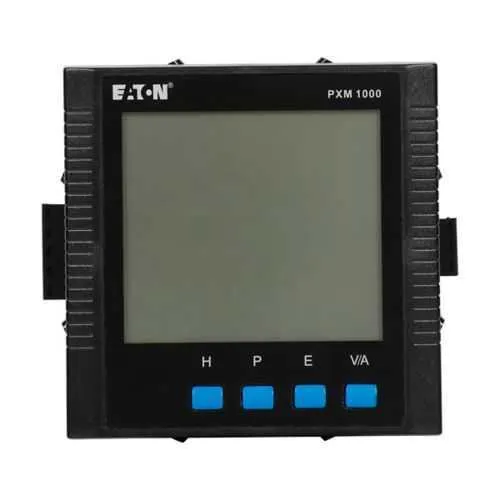
Quick Summary
Power Xpert Meter 1000 provides precise power and energy monitoring for industrial facilities. This compact device helps you see real-time energy use to optimize throughput and reduce waste. UL Recognized and CE Marked certifications help ensure safety and regulatory compliance across global deployments, while the built-in RS485 port supports Modbus-RTU and DNP3.0 for seamless integration. With a flexible power supply and DIN-rail mounting, it fits easily into existing panels, enabling faster commissioning and scalable energy management across multiple sites.
Product Information
Extended Description
PXM1000TB15-1 Eaton: PXM 1000 power and energy meter, Ring Terminal, Din-rail mount transducer without display,, Frequency range 45-65Hz, Nominal current input 5A, Power supply 100-415Vac or 100-300Vdc, Built-in RS485 port with Modbus-RTU and DNP3.0 protocol
Product Name
Eaton Power Xpert meter 1000
Catalog Number
PXM1000TB15-1
UPC
786689772024
Product Length/Depth
5 in
Product Height
4.5 in
Product Width
5 in
Product Weight
0.89 lb
Compliances
Contact Manufacturer CE Marked
Certifications
UL Recognized
Power Xpert Meters
Power Xpert Meters
Power Xpert Meter 1000 meter software version 3.7.3
Eaton Specification Sheet - PXM1000TB15-1
The PXM1000TB15-1 is designed for rapid installation in modern control panels, delivering accurate energy data with a DIN-rail mount and ring terminal connections. This compact transducer accepts a nominal 5A input and operates from 100-415 VAC or 100-300 VDC, providing flexible power to diverse installations and simplifying retrofits in mixed electrical environments. In practice, this translates to lower wiring complexity, reduced panel footprint, and quicker diagnostics when energy anomalies occur. With a frequency range of 45-65 Hz, the meter remains reliable in regions outside strict 50/60 Hz standards, supporting global applications. The built-in RS485 port enables Modbus-RTU and DNP3.0 communications, ensuring compatibility with existing SCADA/EMS platforms and minimizing integration risk. Certifications (UL Recognized and CE Marked) support compliance in regulated industries, while the lightweight form factor (5 in x 5 in x 4.5 in, 0.89 lb) eases installation in space-constrained panels. These features collectively translate into measurable efficiency gains, lower total cost of ownership, and faster time-to-value for energy-management initiatives.
Get a Quick Quote for a Eaton PXM1000TB15-1
Chat with us on WhatsApp - fast responses guaranteed
Need to speak with someone? We'll call you back within 2 hours during business hours
Interested in Eaton PXM1000TB15-1?
Enquire Now
FAQs
The PXM1000TB15-1 is designed for DIN-rail mounting with a compact 5 in x 5 in x 4.5 in footprint and a weight of 0.89 lb. It offers ring terminal connections and supports dual power inputs (100-415 VAC or 100-300 VDC), simplifying retrofits in mixed-voltage environments and minimizing panel disruption during installation.
The meter includes a built-in RS485 port that supports Modbus-RTU and DNP3.0, enabling straightforward integration with existing SCADA, EMS, and energy management systems without requiring additional gateways.
Yes. The device is UL Recognized and CE Marked, indicating compliance with safety and regulatory requirements for both North American and international deployments. Users should verify regional installation standards, but the metering module itself satisfies common certification expectations.
Key specs include a nominal 5A input, supply options of 100-415 VAC or 100-300 VDC, and a frequency range of 45-65 Hz. These enable accurate energy measurement across diverse electrical systems, supporting reliable billing, reporting, and capacity planning.
By providing real-time energy data and compatible communications (Modbus-RTU/DNP3.0), the meter improves visibility, enabling targeted optimization, reducing peak demand charges, and accelerating commissioning timelines in retrofit projects. The compact form factor and flexible power input further lower installation costs and panel space requirements.