
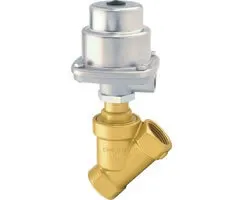
Norgren 8218400.9100.00000 Brass Valve - 2/2 NC G1
Part Number: 8218400.9100.00000
Quick Summary
Norgren 8218400.9100.00000 is a brass angle seat valve that delivers high-flow control for gas and liquid processes. In rugged process environments, contamination and slow response can drive downtime and maintenance costs. Regulatory considerations such as CE conformity and IP ratings often influence valve selection, while SIL safety analyses guide risk management. The brass body, PTFE seat, and damped closing support reliability and long service life in demanding service. This valve’s G1 port, 25 mm nominal diameter, and 0–10 bar operating range enable efficient, compliant automation across a wide range of applications with reduced energy use and maintenance needs. Its external pilot signal option (fluid) broadens integration options in centralized control schemes.
Product Information
Extended Description
8218400.9100.00000 Norgren: High flow rate | Suitable for contaminated process fluid | Damped closing and back pressure tight | Suitable for vacuum up to max. 90% | External pilot signal could be fluid
Medium
Gases, Liquids
Operating Temperature
-10 ... 180 °C, 14 ... 356 °F
Operating Pressure
0 ... 10 bar, 0 ... 145 psi
Port Size
G1
Function
NC
Nominal Diameter
25 mm
Valve operation
2/2
Materials - Body
Brass
Materials - Seat Seal
PTFE
Range
82180
Brand
IMI Buschjost
Feature: Gases and Liquids compatibility with a 25 mm nominal diameter and 2/2 NC operation. Business impact: Broad media compatibility reduces part counts and simplifies stocking, speeding up maintenance and replacements. Application: Suitable for mixed media lines in process automation. Feature: Wide operating range of -10 to 180 °C and 0–10 bar. Business impact: Enables a single valve to cover diverse process conditions, reducing SKU proliferation and shimming downtime. Application: Chemical and general industrial gas/liquid circuits. Feature: Brass body with PTFE seat and damped closing. Business impact: Excellent chemical resistance and leak-tight performance with minimized wear and shorter cycle times. Application: Contaminated-fluid lines and high-cycle applications. Feature: High flow and back-pressure tight design with vacuum capability up to 90%. Business impact: Improves throughput and reliability under challenging upstream conditions, lowering energy costs and waste. Application: Vacuum-assisted or pressure-stabilized lines in automation schemes. Feature: External pilot signal option (fluid). Business impact: Flexible control architecture, easier retrofits, and compatibility with centralized or distributed pilot systems. Application: Systems requiring fluid-pilot or remote actuation in a standard G1 port footprint.
Get a Quick Quote for a Norgren 8218400.9100.00000
Chat with us on WhatsApp - fast responses guaranteed
Need to speak with someone? We'll call you back within 2 hours during business hours
Interested in Norgren 8218400.9100.00000?
Enquire Now
FAQs
The valve features a G1 port with a 25 mm nominal diameter and a 2/2 normally closed (NC) configuration. This standard footprint simplifies substitution in legacy systems and enables straightforward integration with common automation manifolds.
Yes. The valve is rated for gases and liquids, with a brass body and PTFE seat providing broad chemical compatibility. It operates from -10 to 180 °C and 0 to 10 bar, making it versatile for mixed-media process lines in industrial automation.
The design supports vacuum service up to 90%, with damped closing aiding tight shut-off under varying upstream pressures. This makes it suitable for vacuum-assisted lines when paired with appropriate upstream control.
The valve uses a standard G1 port and external pilot signal capability. It can be integrated into centralized or fluid-pilot control schemes, allowing flexible automation architecture and easier retrofits into existing lines.
A damped closing action reduces pressure surges and wear, while the PTFE seat and brass body provide durable chemical resistance. These features translate to longer cycle life, lower leakage risk, and reduced maintenance frequency in demanding industrial environments.