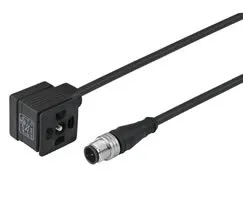
Norgren NC-DINAA-123MS-A Valve Connector - IP67
Part Number: NC-DINAA-123MS-A
Quick Summary
Norgren NC-DINAA-123MS-A valve connector delivers DIN-form A connectivity for rugged automation panels and valve assemblies in demanding environments. In busy control rooms, wiring errors and lengthy installation times slow commissioning—this premade, plug-and-play solution addresses that pain point directly. Key specs include an IP67 rating for robust protection, a 3-pin M12 A-coded interface, and a 0.6 m cable length, all in the compact DIN form factor. By aligning with standard wiring practices and modular NC-series blocks, it enables faster deployments and easier future upgrades. For engineers and procurement teams, this means lower installed costs and greater site reliability across industrial Ethernet and valve-control networks.
Product Information
Extended Description
NC-DINAA-123MS-A Norgren: Industrial Ethernet connectivity products | Standard building blocks make system design modular and simple | Installation time is reduced as all cables are premade, plug and socket, making it all plug and play
Cable Length
0.6 m
Certification - IP Rating
IP67
Series
NC series
Brand
IMI Norgren
Feature → Business Impact → Application: Premade plug-and-play cables cut installation time and reduce wiring errors, delivering faster commissioning and lower labor costs. In practice, panel builders can deploy IOC-ready connections with minimal field termination, boosting project throughput on machine lines and packaging lines. Application: valve control assemblies in automated production lines. Feature → Business Impact → Application: IP67-rated protection ensures reliable operation in dusty, damp, or wash-down environments, reducing unplanned downtime and service calls. Application: rugged manufacturing floors, process plants, and outdoor installations. Feature → Business Impact → Application: DIN form A, M12 A-coded 3-pin interface provides compatibility with common sensors and actuators, reducing sourcing risk and supplier fragmentation. Application: standard automation architectures and IO-link style networks. Feature → Business Impact → Application: 0.6 m cable length offers a balanced routing option that fits compact control panels while preserving signal integrity. Application: compact valve panels and modular automation blocks. Feature → Business Impact → Application: NC-series modular design simplifies substitutions and upgrades, lowering total cost of ownership through reusable components. Application: scalable factory-floor systems where future reconfiguration is common.
Get a Quick Quote for a Norgren NC-DINAA-123MS-A
Chat with us on WhatsApp - fast responses guaranteed
Need to speak with someone? We'll call you back within 2 hours during business hours
Interested in Norgren NC-DINAA-123MS-A?
Enquire Now
FAQs
This connector uses a DIN form A 3-pin M12 interface, with premade 0.6 m cable length for straightforward mating to compatible valves and sensors. Align the A-coded orientation, connect to the mating receptacle, and secure with standard locking nuts to ensure a vibration-resistant, plug-and-play connection that minimizes field terminations.
The device features a 3-pin M12 A-coded interface within a DIN form factor and is IP67 rated for dust and water ingress protection. This combination supports reliable signal and power transfer in demanding environments, suitable for industrial Ethernet and valve control applications.
Yes. The IP67 rating and DIN form A, M12 A-coded 3-pin configuration make it well-suited for harsh manufacturing floors, wash-down zones, and standard automation networks where common sensors and actuators connect via robust, field-ready cabling.
The product communicates compliance through its IP67 ingress protection rating and adherence to DIN form factor and M12 connector standards. These characteristics align with common industrial wiring practices and facilitate integration with widely used components in automation equipment.
Premade plug-and-play cables reduce installation labor, minimize field termination errors, and shorten commissioning time. This translates to faster project startups, lower field-rework costs, and a more predictable maintenance footprint, improving overall ROI for scalable automation projects.