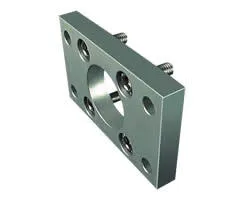
Norgren QA/8080/22 Pneumatic Cylinder - Front/Rear Flange Mounting 80 mm Bore
Part Number: QA/8080/22
Quick Summary
QA/8080/22 from Norgren is a precision pneumatic cylinder for compact automation in packaging and assembly lines. Engineers often struggle with mounting versatility and consistent performance in tight spaces. This solution aligns with standard industrial certifications such as CE marking and robust IP-rated housing where applicable, helping ensure safety and reliability. This combination supports faster integration, lower refurbishment costs, and compatibility with Norgren mounting accessories and ISO-standard fittings.
Product Information
Cylinder diameter
80 mm
Dimensions - Height
16 mm
Dimensions - Length
154 mm
Dimensions - Width
100 mm
Weight
1.35 kg
Country of Origin
Germany
Brand
IMI Norgren
Feature: 80 mm bore delivers precise actuation with strong push force within a compact envelope. Business impact: higher power density reduces machine size while maintaining performance, enabling faster line speeds. Application: ideal for compact packaging cells and small-assembly tasks where space is at a premium. Feature: Slim profile with a height of 16 mm, length of 154 mm, and width of 100 mm. Business impact: reduces overall machine footprint and simplifies system integration, lowering enclosure complexity. Application: suitable for tight automation cells, gantry axes, and conveyor-fed pick-and-place setups. Feature: Weight of 1.35 kg lowers moving mass for improved acceleration and reduced energy use. Business impact: contributes to shorter cycle times and lower wear, improving total cost of ownership. Application: high-repeatability tasks in high-speed lines with moderate payloads. Feature: Front/Rear flange mounting (BG mounting) provides versatile installation options and easier retrofit. Business impact: faster commissioning and reduced downtime when upgrading legacy lines. Application: retrofits in existing automation architectures and new builds requiring flexible mounting. Feature: Ready access to CAD and datasheet downloads supports rapid design and verified integration. Business impact: reduces engineering time, minimizes misfits, and accelerates approvals. Application: device selection for automotive, electronics, and consumer goods packaging lines.
Get a Quick Quote for a Norgren QA/8080/22
Chat with us on WhatsApp - fast responses guaranteed
Need to speak with someone? We'll call you back within 2 hours during business hours
Interested in Norgren QA/8080/22?
Enquire Now
FAQs
Begin by aligning the actuator bore with the mounting holes on the plate or end covers, then secure with appropriate fasteners to two opposite flanges. Check parallelism to ensure piston travel is true, and verify space for end-of-stroke cushions if used. Use Norgren mounting accessories to preserve alignment during maintenance and replacements.
Key specs include 80 mm cylinder diameter, 16 mm height, 154 mm length, 100 mm width, and a weight of 1.35 kg. These values influence inertial load, actuator speed, and mounting clearances. Plan for a bit of stroke end clearance and room for fittings to ensure reliable cycles in confined spaces.
Yes. The 80 mm bore provides strong actuation in a compact footprint, and the front/rear flange mounting enables flexible installation in tight packaging stations. Its moderate weight supports rapid cycling, and the availability of CAD data helps engineers validate fit and function during line design and retrofit projects.
The datasheet and manufacturer specifications should be consulted to confirm CE compliance and any IP ratings applicable to your environment. Because the provided data does not list certifications explicitly, verify these details in the official datasheet or with a Norgren representative before qualification for regulated installations.
Rely on Norgren’s robust build and available CAD resources to simplify spare-part planning and predictive maintenance. The compact design reduces space-related downtime, while reliable actuation minimizes unscheduled stops—contributing to lower maintenance costs and faster ROI on automation projects.