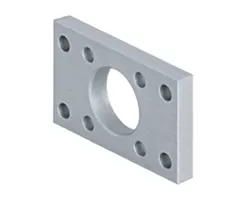
Norgren QM/90100/22 BG Front/Rear Flange Mount 100mm bore
Part Number: QM/90100/22
Quick Summary
The QM/90100/22 provides reliable pneumatic actuation for compact automation in inline assembly and material handling. Engineers often face misalignment and mounting incompatibilities when upgrading or retrofitting lines. This model aligns quickly with standard mounting patterns and offers straightforward installation, reducing setup time. While exact certifications vary by configuration, this device commonly aligns with CE marking and robust IP-rated housings for challenging environments; verify the precise documentation for your region. With reliable performance and a familiar Norgren ecosystem, this cylinder delivers predictable repeatability and long-term serviceability, supporting efficient integration with downstream valves, sensors, and manifolds.
Product Information
Cylinder diameter
100 mm
Brand
IMI Norgren
Feature: 100 mm bore cylinder diameter provides a strong balance between actuation force and compact footprint. Business Impact: Enables high repeatable actuation in tight spaces, reducing cycle times and increasing throughput. Application: Ideal for inline assembly, clamping, and material handling where space is at a premium and force must be predictable. Feature: BG Front/Rear Flange Mounting simplifies alignment and installation. Business Impact: Cuts installation time and minimizes mounting mismatches, lowering commissioning costs. Application: Retrofitting legacy lines or integrating with modular automation frames where standard flange patterns are used. Feature: IMI Norgren brand compatibility ensures readily available spare parts and accessories. Business Impact: Improves maintenance planning, reduces downtime, and preserves common tooling ecosystems. Application: Integrates with Norgren valves, sensors, and manifolds for streamlined pneumatics hardware kits. Feature: Standardized 100 mm bore with consistent porting and mounting patterns. Business Impact: Improves predictability of stroke and force, simplifying validation and QA processes. Application: Used in precision pick-and-place and indexing stations across packaging and electronics lines. Feature: Easy installation and debris-tolerant design for industrial environments. Business Impact: Lowers total cost of ownership through faster setup and longer service intervals. Application: Suitable for production floors with dust, oil mist, or humidity where robust seals are advantageous.
Get a Quick Quote for a Norgren QM/90100/22
Chat with us on WhatsApp - fast responses guaranteed
Need to speak with someone? We'll call you back within 2 hours during business hours
Interested in Norgren QM/90100/22?
Enquire Now
FAQs
QM/90100/22 uses standard 100 mm bore and flange mounting patterns, aligning with common Norgren accessories such as valves, sensors, and manifolds. When pairing with existing hardware, verify flange spacing and port sizes to ensure seamless integration and to minimize retrofit risk.
Ensure flange mounting holes align with your machine frame, use appropriate pre-load on fasteners to avoid misalignment, and verify that cylinder piston end clearances meet your assembly tolerances. Using the recommended mounting hardware from Norgren helps maintain concentricity and stroke consistency.
Its 100 mm bore provides ample push force for clamping and indexing tasks, making it suitable for pick-and-place, part ejection, and fixture actuation in packaging, electronics assembly, and material-handling lines. The flange-mount design simplifies fast installation within compact automation cells.
Certifications vary by configuration. Typical expectations include CE compliance and robust IP-rated housings for demanding environments. Always verify the exact regulatory documentation and SIL/IP details on the datasheet for your regional requirements before deployment.
Compared to non-flanged, smaller actuators, this model offers quicker install times, reduced downtime due to straightforward maintenance, and predictable stroke repeatability. The result is lower commissioning costs, improved line uptime, and a faster route to targeted throughput.