
Norgren RA/192100/JM/40 ISO Compact Cylinder - ISO 21287
Part Number: RA/192100/JM/40
Quick Summary
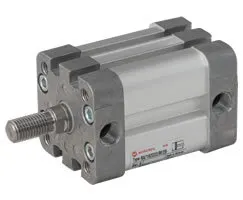
Norgren RA/192100/JM/40 is a compact ISO double-acting pneumatic cylinder for precision actuation in automated lines. Engineers often grapple with limited space and misalignment that disrupt cycle times, so a robust, space-efficient actuator is critical. This model complies with ISO 21287, features a magnetic piston for reliable sensing, and uses buffer cushioning to minimize start/stop impact. With a 100 mm bore and 40 mm stroke, installation is straightforward in standard frames, while the anodised aluminium barrel and martensitic stainless steel rod deliver durable performance. These attributes translate into predictable actuation, reduced maintenance, and improved uptime across demanding manufacturing environments.
Product Information
Extended Description
RA/192100/JM/40 Norgren: Conforms to ISO 21287 | Magnetic piston as standard | Low friction, long life seals | Switches can be mounted flush with the profile
Medium
Compressed air
Operating Temperature
-5 ... 80 °C, 23 ... 176 °F
Operating Pressure
1 ... 10 bar, 15 ... 145 psi
Standard
ISO 21287
Port Size
G1/8
Cylinder diameter
100 mm
Stroke Length
40 mm
Operation
Double acting
Cushioning
Buffer cushioning
Magnetic/Non-magnetic
Magnetic
Theoretical Force
4710 N
Materials - Barrel
Anodised aluminium
Materials - Piston Rod
Stainless steel (martensitic)
Country of Origin
Germany
Range
RA/192000/M
Series
ISO Compact
Brand
IMI Norgren
ISO 21287 compliance and compact footprint enable uniform mounting in tight assemblies, reducing machine footprint and simplifying spare parts management. The result is faster installation, easier service, and lower total cost of ownership when scaling automation across multiple lines. The 100 mm bore delivers strong force without excessive actuator size, giving you reliable actuation for routine clamping, pick-and-place, and transfer tasks while preserving space in crowded control cabinets. Theoretical force rated at 4710 N translates to high-load capability for dependable performance under typical pneumatic cycles, improving cycle times and throughput in packaging and handling applications. The 40 mm stroke provides ample travel for standard actuations, with buffering ensuring smooth starts and reduced vibration at end-of-stroke, boosting equipment longevity. A magnetic piston supports straightforward integration with position sensors and control logic, easing feedback loops and enabling safer, more accurate automation sequences. Buffer cushioning minimizes impact shocks, lowering component wear and maintenance needs in high-cycle environments. The Piston Rod made from martensitic stainless steel and the Barrel from anodised aluminium strike a balance between strength and weight, delivering corrosion resistance and predictable performance in production plants. The G1/8 port size aligns with common pneumatic fittings, enhancing compatibility with existing manifolds and valve banks, while operating pressure from 1 to 10 bar covers typical industrial air systems. Overall, this ISO compact cylinder supports consistent actuation with straightforward installation, minimizing retrofits and enabling scalable automation in a range of manufacturing sectors.
Get a Quick Quote for a Norgren RA/192100/JM/40
Chat with us on WhatsApp - fast responses guaranteed
Need to speak with someone? We'll call you back within 2 hours during business hours
Interested in Norgren RA/192100/JM/40?
Enquire Now
FAQs
RA/192100/JM/40 uses the ISO Compact form factor with a 100 mm bore and a G1/8 port, aligning with standard ISO mounting dimensions. It fits typical pneumatic manifolds and factory frames designed for ISO–21287 cylinders. When installing, verify bore alignment, ensure fluid connections are tight, and use appropriate mounting brackets to maintain parallel alignment for predictable stroke performance. This minimizes side loads and ensures consistent actuator life in high-cycle applications such as packaging and material handling.
The RA/192100/JM/40 offers a theoretical force of 4710 N, which translates to strong actuation for clamping, moving heavy parts, or driving end-of-line devices. In real-world cycles, this force supports high-load positioning while maintaining smooth movement thanks to buffer cushioning. Designers should select this cylinder when their load profile approaches the upper end of standard pneumatic cylinders without resorting to larger, space-consuming actuators, thereby protecting cycle times and reducing mechanical stress.
Yes, with a compact ISO 21287 body, magnetic piston for reliable sensor feedback, and buffer cushioning to minimize impact, the RA/192100/JM/40 supports repeatable, mid-to-high speed pick-and-place operations. The 40 mm stroke is adequate for typical transfer steps, while low-friction seals extend life under fast cycling. For precision positioning, pair the cylinder with appropriate sensors and a closed-loop control strategy to achieve consistent dwell times and repeatable stroke endpoints.
The data specifies ISO 21287 as the standard for this cylinder, along with a magnetic piston and robust construction. There are no explicit CE, SIL, or IP ratings listed in the provided spec. If your application requires CE conformity or IP protection, verify with the supplier or conduct a formal certification check based on your system integration and enclosure criteria. The magnetic piston aids sensor integration, which supports compliant automation architectures while maintaining safe operation within standard pneumatic environments.
Buffer cushioning reduces peak impact forces at cycle end, lowering wear on seals, rods, and end attachments. This leads to longer service intervals, fewer unplanned maintenance events, and lower replacement costs in high-cycle lines. In practice, users can expect improved uptime and lower total cost of ownership as routine preventative maintenance becomes less disruptive. For ROI, factor in extended actuator life, reduced downtime, and compatibility with standard air systems to minimize retrofit expenses during plant-wide automation upgrades.