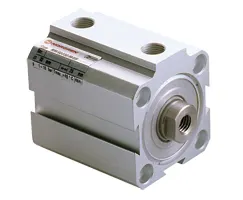
Norgren RM/92016/N4/5 Pneumatic Cylinder - Magnetic piston
Part Number: RM/92016/N4/5
Quick Summary
Pneumatic cylinder RM/92016/N4/5 provides compact double-acting actuation for precise linear motion in automated handling and assembly systems. Engineers often struggle with space constraints, maintenance burdens, and inconsistent performance in tight automation layouts; this model reduces footprint without sacrificing reliability and simplifies installation. Industry standards commonly involve CE marking and IP protection, while SIL-driven safety integration may be required on risk-critical lines. With its magnetic piston, corrosion-resistant construction, and long-life seals, it supports sensor-compatible control and rapid deployment within modern automated cells, delivering lower downtime, predictable cycling, and throughputs that improve overall equipment effectiveness.
Product Information
Extended Description
RM/92016/N4/5 Norgren: One third the basic length of a corresponding ISO/VDMA model | Low friction, long life seal design | Fully non-corrodible specification | Standard magnetic piston for full control system versatility
Medium
Compressed air
Operating Temperature
-5 ... 80 °C, 23 ... 176 °F
Operating Pressure
1 ... 10 bar, 14 ... 145 psi
Port Size
M5
Cylinder diameter
16 mm
Stroke Length
5 mm
Operation
Double acting
Cushioning
No cushioning
Magnetic/Non-magnetic
Magnetic
Theoretical Force
121 N
Materials - Barrel
Anodised aluminium alloy
Materials - Piston Rod
Stainless steel (austenitic)
Range
RM/92000/M
Brand
IMI Norgren
Feature: Compact 16 mm bore with a 5 mm stroke enables a significantly smaller footprint than many ISO/VDMA models. Business Impact: Frees valuable machine real estate and simplifies enclosure design, reducing overall system size and integration time. Application: Ideal for tight automation cells, small robotic arms, and indexing modules where space is at a premium. Feature: Low friction, long-life seal design minimizes wear and maintenance cycles. Business Impact: Extends service intervals, lowers total cost of ownership, and improves uptime. Application: Suitable for continuous-duty cycles in production lines with demanding duty cycles. Feature: Fully non-corrodible specification shields performance in challenging environments. Business Impact: Reduces corrosion-related downtime and extends component life, improving total equipment effectiveness. Application: Harsh or humid environments, food and beverage, pharma, and clean-room areas. Feature: Standard magnetic piston enables easy sensing and full control-system versatility. Business Impact: Simplifies integration with magnetic sensors and position feedback, accelerating commissioning. Application: Automated cells requiring reliable position sensing and repeatable actuation. Feature: Operating range 1–10 bar and -5 to 80 °C expands deployment options. Business Impact: Supports diverse plants with varying pressure supplies and ambient conditions, minimizing equipment skews. Application: General industrial automation, pick-and-place, and linear actuators in mixed environments. Feature: Stainless steel piston rod and anodised aluminium barrel provide robust, long-lasting operation. Business Impact: Enhances durability, reduces maintenance, and improves resistance to contamination. Application: Food-grade, wash-down, and high-dirt environments where cleanliness matters. Feature: Theoretical force of 121 N and 16 mm bore deliver dependable actuation for compact payloads. Business Impact: Predictable performance enables accurate motion control and repeatable cycles. Application: Small-part handling, precise positioning, and light-to-medium load tasks. Feature: Range RM/92000/M compatibility allows streamlined selection within the Norgren RM family. Business Impact: Simplifies specification, stocking, and maintenance planning. Application: Integrated lines using multiple RM stages and standardized control interfaces.
Get a Quick Quote for a Norgren RM/92016/N4/5
Chat with us on WhatsApp - fast responses guaranteed
Need to speak with someone? We'll call you back within 2 hours during business hours
Interested in Norgren RM/92016/N4/5?
Enquire Now
FAQs
The RM/92016/N4/5 uses a 16 mm bore and M5 port, enabling straightforward mounting to standard compact manifolds and brackets. For reliable installation, match the mounting pattern to the cylinder body, secure fittings with appropriate torque, and leverage the magnetic piston for easy sensor placement. Ensure supply pressure within 1–10 bar and temperature range of -5 to 80 °C. Refer to the datasheet for recommended fasteners and hardware compatibility.
Theoretical force is 121 N at the specified bore, with an operating pressure range of 1–10 bar and a temperature range of -5 to 80 °C. This enables reliable actuation in light to medium-duty tasks across varied environments. For peak performance, ensure the load profile stays within the cylinder’s dynamic capabilities and verify cycle rates in your application using the datasheet as a reference.
Yes, its compact length and 16 mm bore are beneficial for tight layouts, supporting repeatable positioning. However, there is no cushioning, so very high-speed applications should account for impact forces and mechanical stops. For high-cycle operations, evaluate actuation speed, mass, and deceleration requirements, and consider sensor feedback to optimize motion curves and reduce wear.
Certification requirements vary by region. Check for CE marking to satisfy European conformity and verify any region-specific IP protection or safety-related certifications as applicable to your facility. If your line requires SIL-level safety integration, confirm compatibility with your safety system and related components. Always consult the latest datasheet and local standards for confirmation.
The combination of long-life seals and a non-corrodible build reduces maintenance frequency and downtime, improving line throughput. The magnetic piston simplifies sensor integration, speeding commissioning and reducing fault diagnostics. Space savings lower machine footprint and potentially enable higher overall equipment effectiveness (OEE) in automation cells, contributing to a favorable total cost of ownership over the lifecycle.