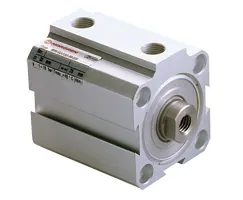
Norgren RM/92020/JM/35 Compact Cylinder - Magnetic
Part Number: RM/92020/JM/35
Quick Summary
Norgren RM/92020/JM/35 compact cylinder provides reliable double-acting pneumatic actuation for confined-space automation. In tight cells, space and maintenance demands harm line efficiency, so this cylinder is engineered to minimize footprint while delivering long-life sealing and smooth motion. Designed for broad industrial use, it supports CE-like control-system compatibility and standard magnetic piston sensing to simplify integration. With a 20 mm bore, 35 mm stroke, and 188 N of theoretical thrust, it enables precise, repeatable linear motion in automated lines while reducing downtime and inventory friction. The result is easier supplier coordination, consistent performance, and smoother operation in compressed-air systems and compact installations.
Product Information
Extended Description
RM/92020/JM/35 Norgren: One third the basic length of a corresponding ISO/VDMA model | Low friction, long life seal design | Fully non-corrodible specification | Standard magnetic piston for full control system versatility
Medium
Compressed air
Operating Temperature
-5 ... 80 °C, 23 ... 176 °F
Operating Pressure
1 ... 10 bar, 14 ... 145 psi
Port Size
M5
Cylinder diameter
20 mm
Stroke Length
35 mm
Operation
Double acting
Cushioning
No cushioning
Magnetic/Non-magnetic
Magnetic
Theoretical Force
188 N
Materials - Barrel
Anodised aluminium alloy
Materials - Piston Rod
Stainless steel (austenitic)
Range
RM/92000/M
Brand
IMI Norgren
Feature: 20 mm cylinder bore and 35 mm stroke create a compact actuator with full double-acting capability. Business Impact: maximizes usable machine space, enabling tighter cell layouts and faster cycle times. Application: ideal for pick-and-place, transfer, and clamping tasks in small automation cells. Feature: Low-friction, long-life seal design reduces wear and maintenance intervals. Business Impact: lowers total cost of ownership by extending service life and reducing downtime. Application: suited for continuous operation in high-cycle packaging and assembly lines. Feature: Fully non-corrodible construction with anodised aluminium barrel and stainless steel piston rod. Business Impact: improves reliability in humid or dusty environments and reduces component replacement costs. Application: outdoor or wash-down areas, or any environment with exposure to contaminants. Feature: Magnetic piston enables full control-system versatility and easier sensing integration. Business Impact: simplifies sensor placement and condition monitoring, improving automation reliability. Application: line-side position sensing and feedback loops in robotics and pick-and-place systems. Feature: Operating range 1–10 bar and temperature range -5 to 80 °C broadens compatibility with standard compressed-air supplies. Business Impact: reduces the need for custom actuation modules; supports standardized maintenance and spare parts. Application: general-purpose automation across automotive, packaging, and material-handling equipment. Feature: M5 port size and 20 mm bore with solid corrosion-resistant materials. Business Impact: faster installation and robust sealing under vibration; minimizes leak-related losses. Application: compact actuator installations in machine frames and control panels. Feature: Theoretical thrust of 188 N provides solid, predictable load performance without oversizing. Business Impact: enables accurate motion profiles and energy-efficient actuation. Application: precise linear actuation in confined-space automation tasks, such as clamping and indexing. Feature: No cushioning specified by design; compatible with external cushioning solutions if needed. Business Impact: offers design flexibility for end customers who require tailored deceleration or damping. Application: high-speed cycles where external dampening is integrated at the fixture level. Feature: Range RM/92000/M ensures consistent family compatibility and streamlined spare-part planning. Business Impact: reduces procurement complexity and ensures predictable performance across line upgrades. Application: system integrations and retrofits in established Norgren-based automation platforms.
Get a Quick Quote for a Norgren RM/92020/JM/35
Chat with us on WhatsApp - fast responses guaranteed
Need to speak with someone? We'll call you back within 2 hours during business hours
Interested in Norgren RM/92020/JM/35?
Enquire Now
FAQs
Mounting requires alignment with the machine framework and ensuring the M5 port is connected to a clean, dry compressed-air supply. Use standard end-mittings or mounting brackets compatible with 20 mm bore cylinders. The magnetic piston enables reliable proximity sensing for quick inline feedback, while the compact length minimizes interference with nearby components.
The cylinder provides a theoretical thrust of 188 N with a 1–10 bar operating range and a temperature tolerance of -5 to 80 °C. It is designed for high-cycle, repeatable motion and features a low-friction seal for extended service life. The 35 mm stroke suits short-throw applications like indexing and clamping in space-constrained layouts.
Yes. The double-acting configuration, compact 20 mm bore, 35 mm stroke, and magnetic piston make it well-suited for precise, repeatable movements in tight spaces. Its robust construction and sensor-ready design support reliable pick-and-place and clamping tasks in electronics, automotive, and packaging lines.
Official product documentation typically references industry-standard compliance such as CE marks and compatibility with common control systems. For exact certification details and IP-related environmental ratings, consult the datasheet linked with the RM/92020/JM/35 product page and the official Norgren publications. The datasheet also confirms material specifications and operating conditions.
The long-life seal design and non-corrodible construction reduce maintenance frequency and spare-part costs, increasing uptime and throughput. Magnetic sensing simplifies integration with existing controls, enabling faster troubleshooting and improved sensing reliability. Overall, operators benefit from lower downtime, predictable performance, and faster line starts in automation projects.