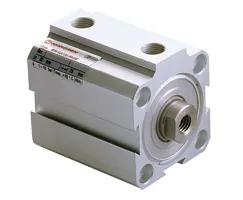
Norgren RM/92032/N2/25 Compact Cylinder - Magnetic Piston
Part Number: RM/92032/N2/25
Quick Summary
Norgren RM/92032/N2/25 Compact Cylinder provides compact, double-acting pneumatic actuation for tight-space automation tasks across manufacturing lines. When space is at a premium, engineers need dependable actuation that delivers repeatable strokes without intrusive maintenance. This model features a 32 mm bore, 25 mm stroke, and a magnetic piston for versatile control system integration, while the low-friction, long-life seals help minimize total cost of ownership. The design uses fully non-corrodible materials and supports a wide operating temperature range and standard compressed-air supply pressures. While certification details are not listed in the provided data, the rugged construction aligns with common industry practices for reliability, safety, and easy integration, making it suitable for a broad array of automation applications. For compatibility, consider the RM/92000/M range for modular options.
Product Information
Extended Description
RM/92032/N2/25 Norgren: One third the basic length of a corresponding ISO/VDMA model | Low friction, long life seal design | Fully non-corrodible specification | Standard magnetic piston for full control system versatility
Medium
Compressed air
Operating Temperature
-5 ... 80 °C, 23 ... 176 °F
Operating Pressure
1 ... 10 bar, 14 ... 145 psi
Port Size
G1/8
Cylinder diameter
32 mm
Stroke Length
25 mm
Operation
Double acting
Cushioning
No cushioning
Magnetic/Non-magnetic
Magnetic
Theoretical Force
483 N
Materials - Barrel
Anodised aluminium alloy
Materials - Piston Rod
Stainless steel (austenitic)
Range
RM/92000/M
Brand
IMI Norgren
Feature: Compact form factor with a 32 mm bore and 25 mm stroke. Business Impact: Enables installation in tight spaces without sacrificing stroke length, reducing overall equipment footprint and enabling quicker line layout. Application: Suitable for small robotic cells and end-of-line pick-and-place stations. Feature: Low friction, long-life seal design. Business Impact: Extends service intervals and lowers maintenance costs by resisting wear and extrusion under typical pneumatic loads. Application: High-cycle manufacture lines where uptime is critical. Feature: Fully non-corrodible construction. Business Impact: Improves durability in washdown and outdoor environments, reducing replacement costs and downtime. Application: Food and beverage, packaging, and automotive assembly lines. Feature: Magnetic piston for control-system versatility. Business Impact: Simplifies sensor integration and feedback across various PLC and motion-control architectures. Application: Inline monitoring and closed-loop positioning. Feature: Lightweight, anodised aluminium barrel and stainless steel piston rod. Business Impact: Combines strength with corrosion resistance for longer life in harsh environments. Application: General purpose automation and material handling. Feature: 1 to 10 bar operating pressure range and -5 to 80 °C temperature tolerance. Business Impact: Offers flexibility across multiple plant air systems and ambient conditions, minimizing configuration constraints. Application: Industrial automation, process lines, and packaging. Feature: No cushioning. Business Impact: Delivers faster response times and reduces travel variations, improving cycle accuracy. Application: Precision positioning tasks and repetitive actuation. Feature: 32 mm bore with 483 N theoretical force. Business Impact: Sufficient actuation force for most compact handling tasks, enabling reliable clamping and pushing operations. Application: Press-fit, fixture actuation, and end-of-arm tooling. Feature: G1/8 port size. Business Impact: Standardized porting simplifies replacement and integration with existing manifolds and air lines. Application: Retrofit and system upgrades. Feature: Materials - barrel (anodised aluminium) and piston rod (stainless steel). Business Impact: Combines light weight with corrosion resistance, extending life in challenging environments. Application: General purpose automation and handling in manufacturing.
Get a Quick Quote for a Norgren RM/92032/N2/25
Chat with us on WhatsApp - fast responses guaranteed
Need to speak with someone? We'll call you back within 2 hours during business hours
Interested in Norgren RM/92032/N2/25?
Enquire Now
FAQs
This model uses a G1/8 port and a 32 mm bore with a 25 mm stroke, designed for straightforward integration into common mounting patterns. Typical installations include side and end mounting with compatible brackets, enabling quick alignment to existing fixtures. For non-standard configurations, confirm space requirements and torque limits in the datasheet to avoid misalignment and ensure consistent actuation.
The cylinder provides a theoretical force of 483 N at nominal conditions. It operates within 1 to 10 bar (14 to 145 psi) and temperatures from -5 to 80 °C. These specs support reliable performance in most standard industrial environments while allowing for compact automation tasks that require decisive push or pull actions.
Yes. With a 32 mm bore, 25 mm stroke, and magnetic piston for easy sensor integration, this cylinder excels in tight spaces typical of pick-and-place applications. Its low-friction seals reduce wear over high-cycle operation, while the non-corrodible materials support long service life in diverse environments, helping maintain cycle times and throughput.
Certification details are not listed in the provided data. To verify compliance for your application, consult the official datasheet via the download link or contact Norgren support. Typical industry project requirements may involve CE, IP ratings, or SIL considerations depending on the installation, so confirm exact standards for your plant and regulatory environment.
The design emphasizes low-friction, long-life seals and corrosion-resistant materials, which reduce maintenance intervals and replacement costs. The magnetic piston supports straightforward sensing and control, enabling predictive maintenance and improved uptime. Overall, expect lower total cost of ownership through increased mean time between failures and faster amortization of initial integration costs.