
Norgren RM1L-NND-NFV Valves & Flow Control - Cartridge Reg
Part Number: RM1L-NND-NFV
Quick Summary
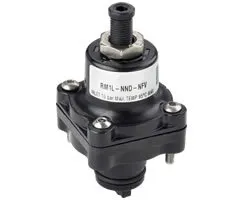
RM1L-NND-NFV is a low-flow miniature precision regulator for compact pneumatic systems in medical and industrial settings. Small footprint and tight flow control often complicate oxygen service and manifold integration. Certification options such as CE, SIL, and IP ratings are commonly specified by end users and system integrators to meet regulatory and safety requirements. This cartridge-style regulator uses PPS body and FPM elastomers to deliver reliable performance across -5 to 95 C and up to 10 bar inlet pressure, with stable 0–4 bar outlet settings. Coupled with Norgren's broader ecosystem, RM1L-NND-NFV offers predictable operation, fast installation, and reduced total cost of ownership across OEM lines.
Product Information
Extended Description
RM1L-NND-NFV Norgren: Suitable for oxygen service, in medical applications | Excellent flow, pressure drop and hysteresis | Cartridge design for manifold integration
Medium
Compressed air, Gases
Operating Temperature
-5 ... 95 °C, 23 ... 203 °F
Port Size
Cartridge
Adjustment
Adjusting screw
Maximum Inlet Pressure
10 bar
Outlet Pressure Adjustment
0 ... 4 bar, 0 ... 60 psi
Relieving / Non Relieving
Non-relieving
Flow
3.3 dm3/sec, 7 scfm
Materials - Body
PPS
Materials - Bonnet
PPS
Materials - Elastomers
FPM
Range
RM1
Brand
IMI Norgren
Feature: Cartridge design enables seamless manifold integration and compact packaging. Business Impact: Reduces cabinet footprint and installation time while improving scalability across multi-valve modules. Application: OEM lines and medical devices where space is at a premium. Feature: Flow and pressure performance deliver precise regulation with high repeatability. Business Impact: Lower system hysteresis, tighter duty cycles, and improved process stability. Application: Pneumatic control loops requiring 0–4 bar output with up to 3.3 dm3/sec flow. Feature: Broad operating temperature and robust materials enhance reliability. Business Impact: Maintains performance in environments from -5 to 95 C and resistive PPS bodies with FPM elastomers reduce chemical attack. Application: Harsh manufacturing floors or oxygen-service equipment. Feature: Non-relieving design and adjustable outlet pressure. Business Impact: Safer, stable supply for critical instruments with predictable response. Application: Medical devices and precision automation lines. Feature: Medium compatibility with compressed air and gases and cartridge port. Business Impact: Simple compatibility checks and faster field retrofit. Application: General purpose regulators within RM1 range across automation and medical contexts.
Get a Quick Quote for a Norgren RM1L-NND-NFV
Chat with us on WhatsApp - fast responses guaranteed
Need to speak with someone? We'll call you back within 2 hours during business hours
Interested in Norgren RM1L-NND-NFV?
Enquire Now
FAQs
Begin with confirming cartridge port alignment and torques specified by Norgren. Remove the regulator housing, insert the cartridge into the manifold slot, and tighten with the adjusting screw accessible from the bonnet. Ensure the inlet is clean and the medium matches the rated compressed air or gas. After installation, verify that the outlet pressure range is set to 0–4 bar using calibrated gauges and test for leaks in the system.
The regulator supports a maximum inlet pressure of 10 bar and provides an adjustable outlet range of 0–4 bar (0–60 psi). It is a non-relieving regulator with a flow capacity of 3.3 dm3/sec (7 scfm). The operating temperature range is -5 to 95 °C (23 to 203 °F). The body and bonnet are made of PPS with FPM elastomers, optimized for reliability in pneumatic and light-gas applications.
Yes, RM1L-NND-NFV is described as suitable for oxygen service and medical applications. Its PPS body with FPM elastomers and cartridge design support cleanliness and compatibility in regulated environments. When deploying in medical devices, verify system-level certifications and perform a commissioning protocol to confirm compatibility with your specific oxygen purity requirements and regulatory expectations.
Certification requirements are typically defined by the end user and system integrator. While the product data highlights general suitability for medical and industrial use, you should confirm CE, SIL, IP and other certifications with your supplier or system team based on your geographic and regulatory needs. Always document compliance mapping to your device’s risk assessment and quality management system.
The cartridge design simplifies field servicing and replacement, reducing downtime. PPS body and FPM elastomers offer chemical resistance and long-term stability, limiting downtime due to wear. Its non-relieving build provides predictable pressure behavior, which reduces recalibration frequency. In multi-valve manifolds, the modular cartridge approach lowers spare-part variety and accelerates maintenance workflows, delivering lower total cost of ownership over the system lifecycle.